 China Neodymium And Ferrite Magnets Manufacturer & Supplier



In the field of magnetic components, the term “magnetic ring” is a very broad concept. It can refer to ferrite magnetic rings used for inductance and filtering, or to permanent magnet rings found in motors and sensors. Among these, “encoder magnetic rings” are a type of magnetic component with specialized functions. Many people tend to confuse the two, but in reality, there are significant differences between encoder magnetic rings and ordinary magnetic rings. They differ fundamentally in terms of structure, magnetization methods, and application scenarios.
In terms of definition, ordinary magnetic rings generally refer to circular magnets with a single magnetic pole (commonly 1 N pole and 1 S pole), mainly used for adsorption, fixation, magnetic shielding, and other purposes.
The encoder magnetic ring is a magnetic ring that has undergone precise multipole magnetization and is the core component of a rotary encoder. It is used to cooperate with magnetic sensors (such as Hall chips or magneto resistive elements) to output angle, speed, or position signals.
Encoder magnetic disk ring 62/64 poles 29 x 15 x 1.1 mm
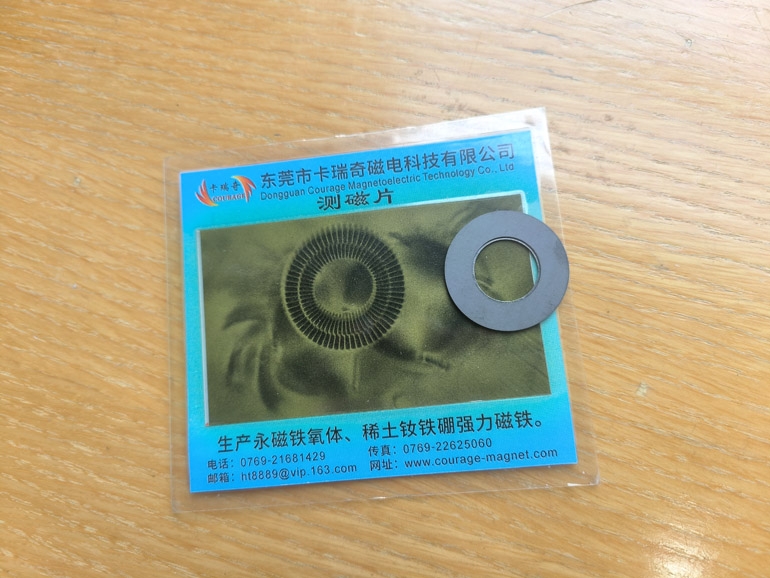
Let's take a look at the differences in their magnetic poles. Ordinary magnetic rings are mostly magnetized with one pair of poles in the axial or radial direction, and the magnetic pole distribution is simple. The encoder magnetic ring needs to undergo high-precision multipole magnetization processing, and the number of magnetic poles can reach dozens or even hundreds of pairs, such as 32 pairs of poles, 64 pairs of poles, 128 pairs of poles, etc. The distribution of magnetic poles must be uniform and the spacing consistent, otherwise it will cause distortion of the encoder signal and decrease in accuracy.
In terms of materials, commonly used materials for ordinary magnetic rings include ferrite, neodymium iron boron, samarium cobalt, etc. Encoder magnetic rings are often made of materials that meet the requirements, such as injection molded magnets and bonded magnets.
Their applications are also very different. Encoder magnetic rings are mainly used in high-precision motion control fields such as robot joints, servo motors, and electric vehicle wheel speed sensors. Ordinary magnetic rings are mainly used for conventional applications such as packaging, speakers, magnetic products, and suppression of high-frequency noise and electromagnetic interference.
The above are the main differences between encoder magnetic rings and ordinary magnetic rings. Our company can customize various multipole encoder magnetic rings, radial magnetic rings, axial magnetic rings and other products, supporting injection molding, bonding, sintering and other processes to meet the needs of different precision and application scenarios.
Related articles on encoder magnetic rings;