 China Neodymium And Ferrite Magnets Manufacturer & Supplier



Injection-moulded magnetic rings and bonded magnetic rings are both common types of permanent magnet materials, and are frequently used in motors, sensors and encoders. This article aims to outline the differences between them.
Differences in Manufacturing Processes
Injection-moulded magnetic rings are produced by mixing magnetic powder with plastic resin and then directly forming them into magnetic rings via the injection moulding process. During production, the material is heated and melted, then moulded in a single step using a mould; consequently, dimensional consistency is excellent, and it is possible to produce magnetic rings with complex structures, positioning grooves or special shapes. Bonded magnetic rings, on the other hand, are typically produced using a compression moulding process, in which magnetic powder is mixed with a binder, moulded into shape and then cured to complete the manufacturing process. This process is relatively simple and is suitable for high-volume production.
Differences in Material Composition
Common materials used for injection-moulded magnetic rings include injection-moulded ferrite and injection-moulded neodymium-iron-boron, among others. These contain a high proportion of resin, which gives the magnets certain plastic-like properties (such as being shatter-resistant) and provides good toughness and processability. Bonded magnetic rings are primarily made from bonded neodymium-iron-boron, in which magnetic powder is bound together using an organic binder; as they contain a higher proportion of magnetic powder, they offer superior magnetic performance for the same dimensions.
Differences in mechanical properties between injection molded magnetic rings and bonded magnetic rings
Injection-moulded magnetic rings are produced in a single moulding process using magnetic powder and plastics (such as PA, PPS, etc.). They offer good overall toughness and high impact resistance, and are less prone to issues such as chipped edges or cracks. Furthermore, they can be moulded as a single unit with metal shafts and plastic components, resulting in higher assembly efficiency; they are therefore suitable for products with complex structures and high dimensional accuracy requirements. By contrast, bonded magnetic rings are typically produced using a compression moulding process. Although they offer good dimensional stability, the material is relatively brittle and is more prone to chipping or corner damage when subjected to significant external forces. Consequently, injection-moulded magnetic rings generally offer greater advantages in applications requiring high mechanical strength, vibration resistance or frequent assembly, whilst bonded magnetic rings are better suited to scenarios where high magnetic performance is required and mechanical loads are relatively low.
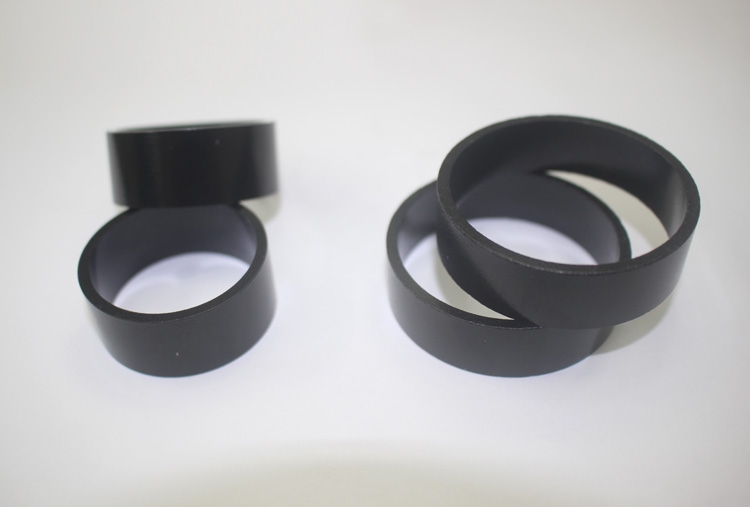
Physical picture of bonded magnetic ring
Their typical application differences
Injection-moulded magnetic rings, owing to their ability to be moulded in a single injection process, high mechanical strength and excellent dimensional consistency, are widely used in products with complex structures and high assembly precision requirements, such as brushless DC motors, water pumps, fans, encoders and various types of sensors. Bonded magnetic rings, on the other hand, offer relatively superior magnetic performance and the ability to easily achieve a high number of magnetic poles. They are therefore commonly used in Hall effect sensors, magnetic encoders, motor rotors, angle sensors, tachometers and various position detection systems—applications that require multi-pole magnetisation and a stable magnetic field output. In simple terms, injection-moulded magnetic rings are better suited to applications involving complex structures and high reliability, whilst bonded magnetic rings are more appropriate for products with stringent requirements for magnetic field precision and magnetic performance.
We are a specialist supplier of motor magnets. Whether you require bonded magnetic rings or injection-moulded magnetic rings, we can manufacture them for you, and we have a wide range of standard sizes in stock. We look forward to receiving your enquiry.
Sample selection;