 China Neodymium And Ferrite Magnets Manufacturer & Supplier



Neodymium-iron-boron magnetic rings are a type of magnet that offers strong magnetic force whilst allowing for a compact design. Depending on the required magnetic field orientation for different applications, these magnetic rings can be magnetised in various ways, with radial bipolar magnetisation being a particularly common method.
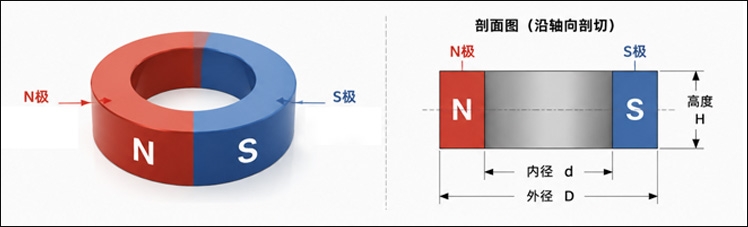
The so-called radial two poles magnetization refers to distributing the magnetic field along the radial direction of the magnetic ring, forming N and S poles on both sides of the magnetic ring. Unlike the magnetic field direction of ordinary axial magnetization, radial magnetization is more suitable for products that require induction of the magnetic field from the side of the magnetic ring.
Schematic diagram of radial 2-pole magnetisation of a magnetic ring
For example, in a Hall sensor, as a radial two-pole magnetic ring rotates, the north and south poles pass alternately in front of the Hall element, generating a changing magnetic field that is used to detect rotational speed, position and direction of rotation. These are commonly found in products such as motors, fans and water pumps.
Radial bipolar magnetic rings can also be used as magnetic components in encoders; by utilising changes in the magnetic field in conjunction with a magnetic encoding chip, they enable angle or position detection. They are particularly suitable for compact devices that require non-contact detection.
Some automated equipment, actuators and rotary mechanisms also utilise radial two-pole magnetic rings for position detection. Compared with mechanical contact-based detection, magnetic detection offers advantages such as non-contact operation, simple design and a long service life.
It should be noted that ‘strong magnetism’ does not simply mean the higher the surface magnetic field, the better. When selecting a suitable product, it is essential to take into account a range of factors, including the dimensions of the magnetic ring, the grade of the material, the operating temperature and the direction of magnetisation. In particular, when used in precision sensors and encoders, magnetic field uniformity and polarity symmetry are often just as important as magnetic field strength. Therefore, when commissioning custom neodymium-iron-boron magnetic rings, it is advisable to provide the actual product’s dimensions, operating distance, detection chip and magnetic field requirements before finalising the material and magnetisation scheme.
Related samples
Radially magnetized high magnetic energy product ring magnet 6x2x2.5
Diametrically Magnetized Ring Magnet N42 OD 15mm
Ultra thin strong magnets radial ring 6.5 x 3.5 x 0.5 mm
More articles on magnetisation;
Ring Magnet With 4 Pole Magnetization on The Inner Circle Surface