 China Neodymium And Ferrite Magnets Manufacturer & Supplier



As the cost of rare-earth materials fluctuates and requirements for high-temperature reliability increase, the application of ferrite permanent magnet materials in the motor industry is gradually expanding. Although their remanence is relatively low, optimal performance can still be achieved through proper motor topology design. Currently, the mainstream ferrite permanent magnet motors primarily include the following four types, each with distinct structural characteristics and design challenges.
I. Permanent Magnet Brushless Motor (PMBM)
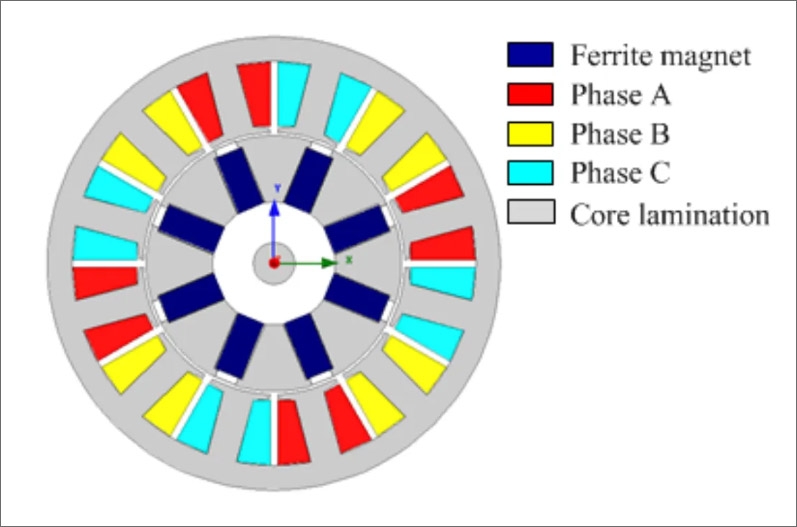
In ferrite systems, traditional surface-mounted structures (SPM) are rarely used; instead, the SPOKE (spoke-type) embedded structure is more commonly adopted. This structure significantly increases the magnetic flux density in the air gap through magnetic flux concentration, thereby compensating for the low residual magnetism of ferrite materials. At the same time, the rotor magnetic circuit design can introduce a certain amount of magnetic resistance torque, enhancing overall output capacity. This type of motor technology is mature and has been widely applied in fields such as fans, pumps, and compressors.
Design Considerations:
Magnet arrangement must enhance magnetic concentration and optimize magnetic bridge thickness and flux paths.
The rotor requires high mechanical strength to prevent damage from high-speed centrifugal forces.
Torque ripple and cogging effects must be optimized through pole-slot matching.
Given the large volume of ferrite materials, both size and cost must be carefully balanced.
Structure of a Ferrite Motor
II. Permanent Magnet-Assisted Synchronous Reluctance Motor (PMa-SynRM)
The PMA-SynRM is an evolution of the traditional Synchronous Reluctance Motor (SynRM), designed to enhance performance by embedding a small number of permanent magnets within the rotor’s magnetic barrier. Its core principle is a hybrid drive mode where reluctance torque serves as the primary source and permanent magnet torque as the secondary source, making it highly suitable for ferrite materials. This configuration typically employs a multi-layer magnetic barrier rotor design, which increases reluctance torque output by raising the pole ratio (Ld/Lq).
Design Considerations:
The design of the number of magnetic barrier layers, their shapes, and positions is complex and highly dependent on simulation.
The arrangement of ferrite magnets must balance flux compensation with cost optimization.
Priority should be given to increasing the pole ratio (typically ≥3) to ensure torque density.
The rotor magnetic bridges are prone to saturation, requiring precise control of structural dimensions.
Control strategies (such as weak-field control) have a significant impact on performance.
III. Permanent Magnet Flux-Switched Motor (PMFSM)
Permanent magnet switched-reluctance motors (FSMs) are motors with a double-salient-pole structure, evolved from switched-reluctance motors (SRMs). Their most distinctive feature is that the permanent magnets are arranged on the stator side, while the rotor consists solely of a magnetic-conducting structure, resulting in high mechanical strength and suitability for high-speed operation. Based on the excitation method, FSMs can be classified into permanent magnet types (PMFSM), wound-field types (WFFSM), and hybrid excitation types (HEFSM). Among these, PMFSMs have lower copper losses and higher efficiency due to the absence of excitation current. This type of motor is currently still in the development stage and has limited engineering applications.
Design Considerations:
The stator’s embedded magnet structure has poor heat dissipation, so temperature rise must be strictly controlled.
The power factor is relatively low, requiring optimization of the winding-to-magnetic circuit matching.
Frequent magnetic circuit switching places high demands on the core material’s loss characteristics.
The structure is complex, making machining and assembly difficult.
Although noise levels are lower than those of SRMs, vibration issues still require attention.
IV. Permanent Magnet Variable-Speed Motors (PMVM)
Permanent magnet variable-speed motors operate based on the principle of magnetic field modulation. Their key feature is that low-speed rotor motion generates high-frequency magnetic field variations, thereby achieving high torque output. Their “gear ratio” is determined by the ratio of the number of rotor poles to the number of stator poles (pr/ps), making them ideal for low-speed, high-torque applications, such as direct-drive systems.
Design Considerations:
High harmonic content in the air gap magnetic field can easily cause eddy current losses in the magnets.
Ferrite has low electrical conductivity, which helps reduce eddy currents but limits magnetic performance.
Low-speed operation results in poor heat dissipation, so special attention must be paid to preventing heat buildup.
The structural design is complex and requires extremely precise pole number matching.
The power factor is relatively low, requiring a larger drive system capacity.
Overall, the core of ferrite motor design lies in compensating for the limitations of the material’s magnetic properties through structural innovation, while striking a balance between size, efficiency, and cost.
Related Products;