 China Neodymium And Ferrite Magnets Manufacturer & Supplier



In the magnet industry, neodymium rare-earth magnets are widely used in various fields due to their superior magnetic properties. Among these, the N35 and N52 grades are commonly used. Many people assume that the N52 grade must be more powerful than the N35 grade, but is that really the case?
First, based on the material specifications themselves, the maximum energy product (BHmax) of N52 is indeed higher than that of N35. This means that under identical volume and magnetic circuit conditions, N52-grade material can deliver a higher magnetic flux output. However, this applies only under “ideal conditions.” In actual operating environments, the dimensions of the magnet (particularly its thickness), the air gap, and the magnetic circuit structure all have a decisive impact on the final magnetic field performance.
The thickness of a magnet often has a greater impact on its magnetic properties than differences in material grade. For example, consider two circular magnets, both 10 mm in diameter: the N35 grade is thicker, while the N52 grade is thinner. In this case, the N35 magnet will actually have a stronger magnetic force than the N52 magnet.
The following image lists the surface magnetic field strength and adsorption force data made of N35 and N52 materials with different thicknesses and a diameter of 10mm magnets
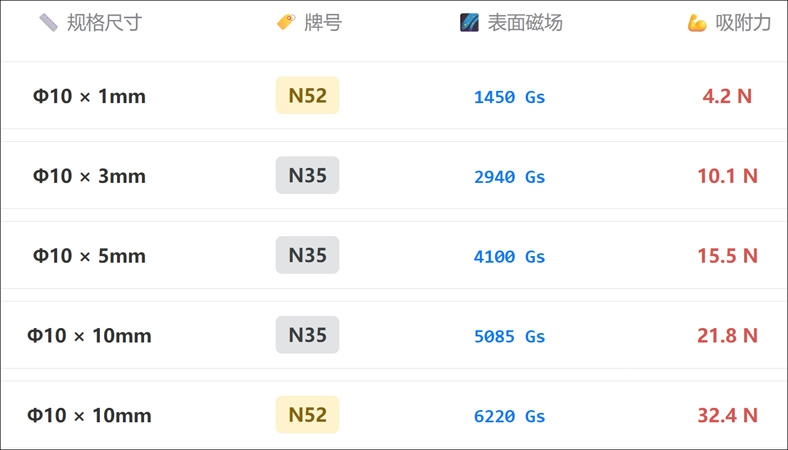
This data clearly shows that when the difference in magnet size is significant enough, the advantages of the material grade are completely offset.
It is undeniably true that N52 has superior material properties to N35. However, the actual magnetic performance of a finished product depends on its dimensions and the measurement location, rather than simply on the grade of the material.
Related article matching;