 China Neodymium And Ferrite Magnets Manufacturer & Supplier



I just came across an interesting question: Why don’t asynchronous motors use magnets in their rotors? What’s the reason behind this? Below, Xiao Fu from NST Magnets will explain this issue.
The fundamental reason why asynchronous motors do not use magnets in their rotors is that their operating principle dictates that “the magnetic field must be induced,” rather than pre-existing. Based on the principle of electromagnetic induction, when current flows through the stator, it creates a rotating magnetic field. This field cuts through the conductors in the rotor, thereby inducing a current in the rotor. This, in turn, generates a rotor magnetic field that interacts with the stator magnetic field to produce torque.
If the rotor of an asynchronous motor is made of magnets, it is no longer an asynchronous motor but a synchronous motor. Synchronous motors are not suitable for use as electric motors, mainly because they are prone to losing synchronization. If you don’t believe me, try connecting a synchronous motor directly to a three-phase power source (mains power, excluding inverters with frequency control capabilities)—it will be very difficult to get it to rotate. Stable operation also requires electronic control. Therefore, when three-phase AC systems were first put into operation many years ago—back when power electronics technology didn’t exist and vacuum tubes were still used—synchronous motors couldn’t be used as electric motors. However, synchronous motors have the ability to automatically regulate their output when operating in generator mode, which is why they are used for power generation. Induction motors, on the other hand, are the exact opposite. They can run stably when directly connected to a three-phase power supply. However, generating power with an induction motor is quite complicated and difficult to stabilize, requiring power electronics technology to control the stator magnetic field.
Schematic diagram of asynchronous motor structure
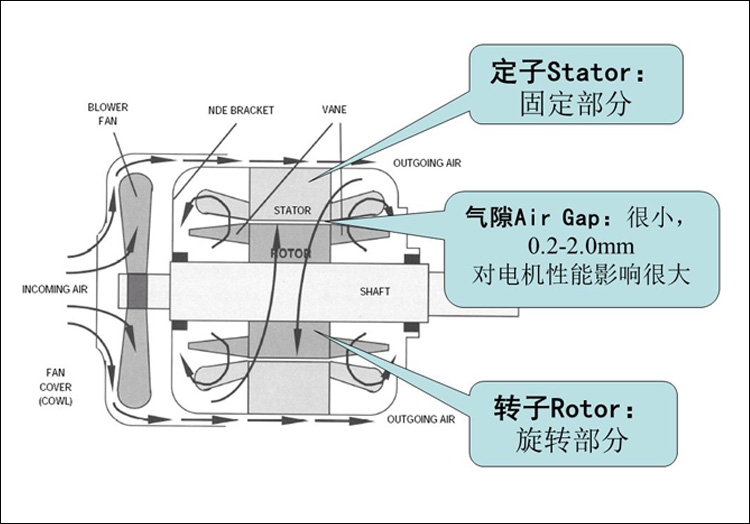
Even today, induction motors remain the most suitable choice for electric motors. They are low-cost, durable, and practically perfect. Permanent magnet synchronous motors are too delicate; most commercial models operate with encoders and are best suited for servo applications. Since synchronous motors require determining the rotor position before starting, they are unsuitable for applications involving frequent starts without a sensor system. Induction motors, however, have no such issue—they simply start spinning as soon as power is applied.
Overall, the fact that induction motors do not use magnets is not due to technical limitations, but rather a result of design choices. By utilizing a simple and reliable principle of induction, they offer advantages such as robust construction, low cost, ease of maintenance, and high adaptability. Therefore, in the vast majority of industrial applications, induction motors remain the preferred solution.
More articles with the same content;