 China Neodymium And Ferrite Magnets Manufacturer & Supplier



In spring pin connectors, the incorporation of magnets is a common structural optimization solution, particularly in consumer electronics, charging ports, and smart devices. This article will focus on the functions and types of magnets used in spring pin connectors.
First, let’s discuss the role of magnets in spring pin connectors. The most obvious function is to provide magnetic attraction, enabling the connectors to automatically align and snap together when brought close. This “magnetic snap-in connection” significantly reduces the difficulty of insertion for users and is commonly found in magnetic charging cables and smart wearable device interfaces. Compared to traditional mechanical insertion and removal, the magnetic snap-in structure offers greater tolerance for user error.
The position of the magnet in the connector
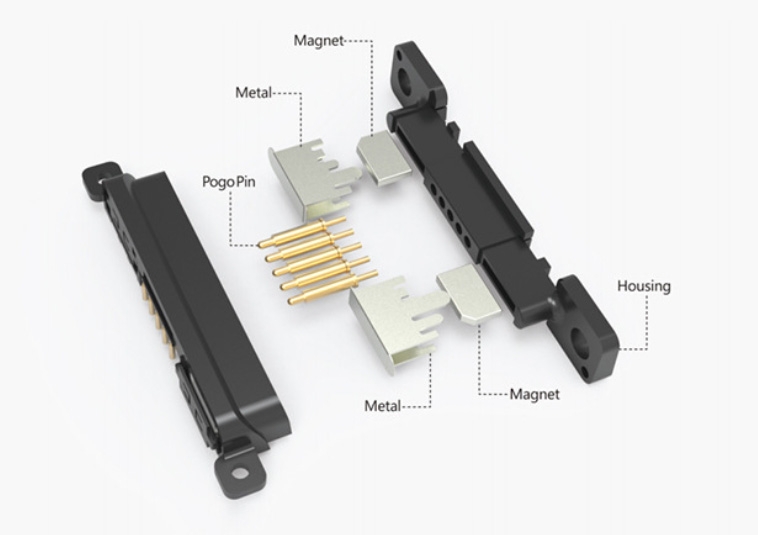
Through the arrangement of magnetic poles (such as N/S pole combinations), directional recognition (anti-reverse insertion) can be achieved, preventing users from connecting the connector in the wrong orientation. This is particularly important in connectors with complex multi-pin configurations and helps ensure circuit safety.
Additionally, the magnetic structure reduces wear caused by mechanical insertion and removal, extending the connector’s lifespan. At the same time, the “automatic attachment” experience offers a distinct competitive advantage in the consumer electronics sector.
Regarding magnet types, neodymium-iron-boron (N52 grade) is currently the primary material used in spring pin connectors. It is highly suitable for miniaturized designs. Common shapes include circular, square, and ring-shaped, though custom shapes—such as stepped or chamfered circular and square designs—are also frequently employed.
When selecting magnets, it is necessary to comprehensively consider magnetic force requirements, magnetization direction, and assembly processes. If you require a quote for magnetic components, please feel free to contact us via email.
Suitable for magnets in connectors;
Custom shape convex disc magnets for connectors 14mm x 9mm