 China Neodymium And Ferrite Magnets Manufacturer & Supplier



When selecting cylindrical magnets, many people ask: for magnets of the same size, material and grade, which is stronger—those magnetised radially or axially?
In fact, there is no definitive answer as to which of the two is ‘stronger’; the main difference lies in the direction of magnetisation and the distribution of the magnetic field. In axial magnetisation, the magnetic poles are located at the top and bottom end faces, whereas in radial magnetisation, the magnetic poles are distributed along the sides of the cylinder; each is suitable for different applications.
If we look at the adsorption capacity, axial magnetization is usually more advantageous. Due to the concentration of magnetic force on two end faces, the utilization rate of magnetic flux is higher when in contact with steel plates or iron parts. Therefore, the surface magnetic force and actual suction force of the end face are generally greater than those of radial magnetization. This is also why most magnets used for adsorption, fixation, and magnetic connection adopt axial magnetization method.
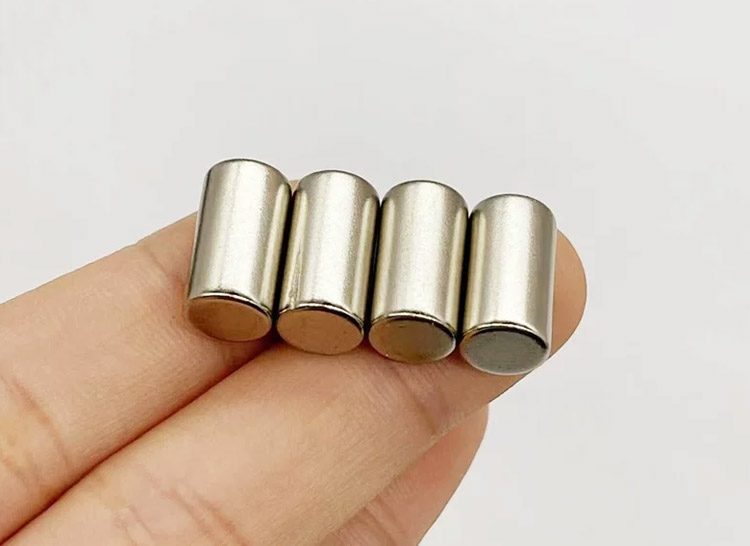
Cylindrical neodymium rare-earth magnets
Although radial magnetisation is less effective than axial magnetisation in terms of adsorption, it offers greater advantages in applications involving rotating magnetic fields. As the magnetic field is distributed along the outer circumference of the cylinder, it is easier to generate a stable radial magnetic field; consequently, it is widely used in products such as brushless motors, encoders, Hall sensors, tachometers and magnetic couplers.
When choosing magnets, we should determine the magnetization method based on the actual usage scenario, rather than simply comparing which one has greater magnetic force.
Articles on cylindrical magnets;