 China Neodymium And Ferrite Magnets Manufacturer & Supplier



In the magnet business, it is common to encounter magnets with very small dimensions, such as those with diameters of only 0.5mm or 1mm, or lengths of only 1.5mm, 2mm, or 3mm. Many people refer to these products as "weak magnets" or "micro magnets". Is this correct?
In fact, these two terms are not entirely the same. ‘Micro-magnet’ primarily emphasises that the magnet is very small, whilst ‘weak magnet’ primarily emphasises that the magnetic force is relatively weak; the criteria for determining the two are different.
For example, a neodymium-iron-boron magnet with a diameter of 1 mm and a ferrite magnet measuring 1x2x3mm can both be classified as miniature magnets. Although such products are small in size, if high-performance neodymium-iron-boron material is used and they are properly designed and magnetised, they can still generate a strong local magnetic field; one should not assume that their magnetic force is weak simply because of their small size.
Small-sized special neodymium magnets
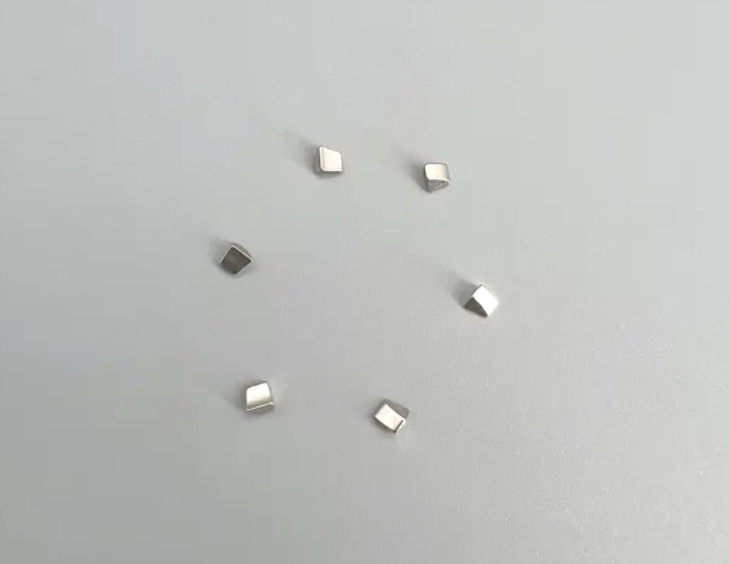
And what about ‘weak magnetism’? This generally refers to a magnetic field of relatively low strength, or a product that exhibits a relatively weak magnetic pull. For example, some small ferrite magnets may be described as ‘weak magnetism’ products because, due to the inherent properties of the material, the measured surface magnetic flux density may be relatively low.
In practice, micro-magnets and weak magnets may also exist; for example, a circular ferrite magnet with a diameter of 2 mm and a thickness of 1.5 mm, which exhibits weak magnetism when magnetised, can be referred to as both a weak magnet and a micro-magnet. However, if we consider high-performance neodymium-iron-boron material, it can also possess a high surface magnetic flux density. Therefore, when assessing the performance of a magnet, one must not rely solely on its external dimensions; attention must also be paid to the magnet’s material, length, width and thickness, as well as its degree of saturation.
For customers requiring miniature magnets, we recommend first determining the specific dimensions of the product, its operating environment and the required magnetic field strength, before selecting the appropriate magnet material. Where the magnets are to be used in products such as sensors, precision instruments or micro-motors, attention must also be paid to the dimensional tolerances of the magnets.
Related miniature magnet products;
Tiny cube ndfeb magnet 1.2mm x 1.2mm x 1.2mm
Extremely small ceramic ferrite block magnet 1x1x2.45mm Y30
Ultra Small and Thin Rare Earth Neodymium Disk Magnet 0.5mm x 0.4mm