 China Neodymium And Ferrite Magnets Manufacturer & Supplier



When it comes to magnetising magnets, the most common methods are single-pole and multi-pole magnetisation. Some internet users have raised the question: are single-pole and multi-pole magnetisation the same thing?
In fact, single-pole and multi-pole magnetisation are not the same thing. Although both methods involve using magnetising equipment to induce magnetism in a magnet, there are clear differences in the number of magnetic poles ultimately formed, the distribution of the magnetic field, and the way they are used.
Put simply, unipolar magnetisation typically results in a magnet forming a pair of main poles, namely the N-pole and the S-pole. Multipolar magnetisation, on the other hand, involves creating multiple N and S poles arranged alternately on the surface of the same magnet, depending on the product requirements.
Taking a standard circular magnet as an example, if axial magnetisation is used, it is generally understood that one face is the N-pole and the other is the S-pole; this is a relatively common form of unipolar magnetisation. Magnets of this type have a simple structure and a clearly defined magnetic field direction, making them suitable for applications such as attraction, fastening and magnetic coupling.
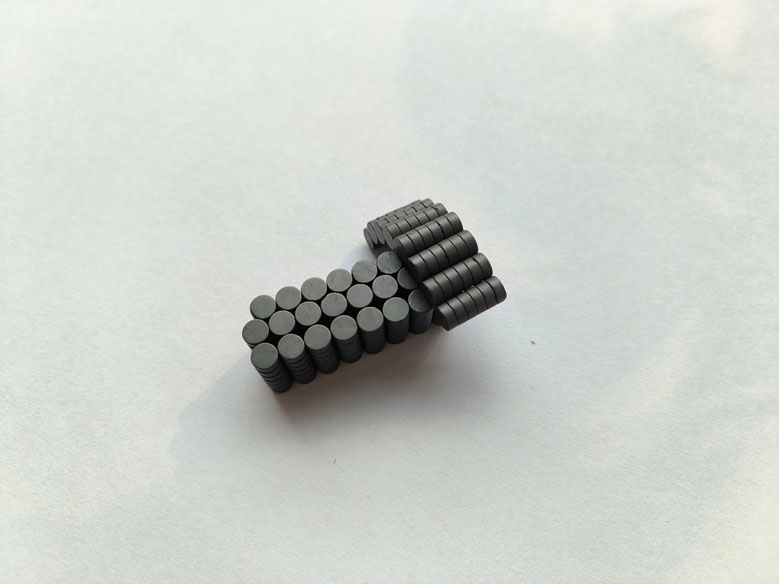
Ordinary circular ferrite magnets
Multi-pole magnetization is different. For example, a magnetic ring can be magnetized to have 4 poles, 6 poles, 8 poles, 10 poles, or even more. After magnetization, the N poles and S poles will be arranged according to a certain pattern, forming multiple magnetic field regions. Especially for products such as motor magnetic rings, encoder magnetic rings, and sensor magnetic rings, multi-pole magnetization is often used. The number of magnetic poles and the arrangement method directly affect the motor torque, position detection accuracy, and sensor output signal.
It should be noted that a larger number of magnetic poles does not necessarily mean a higher surface gauss of the magnet. Multipolar magnetization mainly changes the distribution pattern of the magnetic field, rather than simply adding magnetic forces continuously. As the number of poles increases, the area occupied by each pole will decrease, and the degree of magnetic field concentration, pole spacing, magnet size, and magnetization process will all affect the final surface magnetic field.
Whether you need ordinary single-pole magnets or multi-pole magnets, our company can meet your needs. If you need samples, you can inquire about the price through our online customer service during working hours, or you can also call directly.
Other articles on magnet magnetization;
Magnetisation Methods and Magnetic Pole Distribution for Arc Magnets