 China Neodymium And Ferrite Magnets Manufacturer & Supplier



Many customers encounter the terms "isotropic" and "anisotropic" when purchasing ferrite magnetic rings. From the appearance, there is no obvious difference between the two types of magnetic rings, both of which are circular magnets. However, the real difference lies inside the material. Below is an introduction to the differences between the two.
Firstly, let’s discuss their most significant difference: their orientation. In the case of isotropic magnetic rings, the alignment of the magnetic particles during the moulding process is essentially random; they are not specifically oriented by an external magnetic field, and the orientation of the magnetic particles is rather haphazard—for example, like this: → ↑ ← ↙ ↑ → ↗. The production process is relatively simple, and costs are easier to control, making them suitable for products that do not require particularly high magnetic strength, such as toys and standard magnetic fastening mechanisms.
20mm anisotropic ferrite magnetic ring
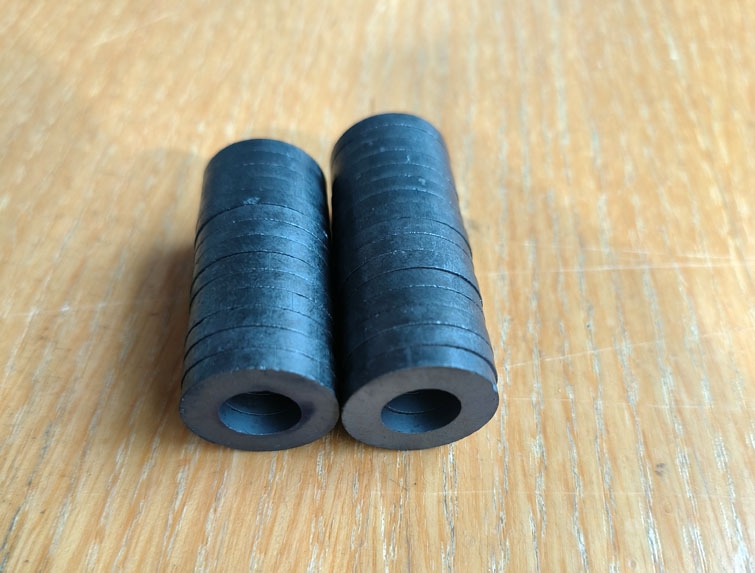
During the moulding process of isotropic magnetic rings, a directional magnetic field is applied to ensure that the magnetic particles in the ferrite magnetic powder align as closely as possible along a specified direction (effectively ‘lining up’ the magnetic powder in advance). This orientation is retained after moulding and sintering. Subsequent magnetisation then enables higher magnetic performance to be achieved.
When making an actual selection, one should not simply assume that ‘heteropolarity is always better than isopolarity’. If a product does not have high magnetic performance requirements and isopolar magnetic rings can meet the application’s needs, there is no need to insist on using heteropolar materials. Conversely, if the product is intended for use in motor rotors, Hall sensors, encoders, multi-pole magnetic rings and similar applications—where there are specific requirements regarding magnetic field strength, the number of magnetic poles and magnetic field distribution—it is necessary to select the appropriate materials and magnetisation methods based on the actual parameters.
We can supply standard ferrite isotropic and anisotropic magnetic rings in accordance with your product requirements, and can also provide multi-pole magnetisation. Please feel free to enquire about prices and samples.
Product selection;