 China Neodymium And Ferrite Magnets Manufacturer & Supplier



When selecting magnets to pair with Hall effect sensors, many people ask a rather practical question: do Hall effect sensors have any specific requirements regarding the N-pole and S-pole of the magnet? Below, we will outline the magnetic pole requirements for some common types of Hall effect sensors.
Take the relatively common unipolar Hall effect sensor, for example: it typically responds only to a specific magnetic pole. When installing a magnet, the corresponding N-pole or S-pole must be oriented towards the Hall effect sensor in accordance with the sensor’s operating requirements. If the magnet is fitted with the polarity reversed, the sensor may fail to activate or the operating distance may vary significantly. Therefore, when selecting a magnet for this type of product, it is important to consider not only the dimensions and magnetic force, but also the direction of magnetisation.
Furthermore, bipolar Hall sensors can respond to both N and S magnetic poles, but the action and release points of different Hall sensor models may not be exactly the same. For example, when a magnet approaches Hall, reaching a certain magnetic induction intensity at the N pole may cause the output to flip. After the magnet leaves, the magnetic field decreases to the release point and the output is restored. Replacing with an S pole may also result in corresponding actions.
Hall commonly used small magnetic rings
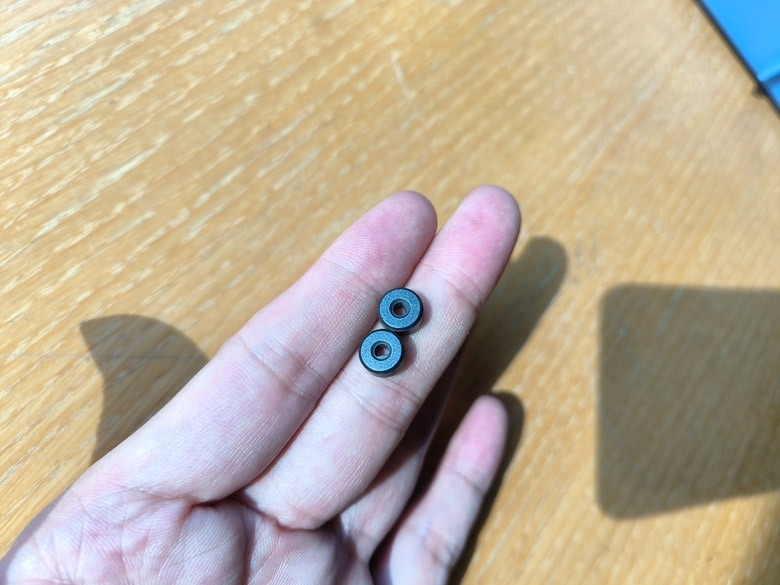
The latch type Hall requires alternating N and S magnetic poles to change the output state. In other words, the latch type Hall is more suitable for using multipole magnets with N/S alternating arrangement (one face with multiple magnetic poles). For example, when a 4-pole, 8-pole, or 10 pole magnetic ring rotates, the N pole and S pole pass through the Hall in sequence, and the Hall output will continue to flip according to the magnetic pole change. Therefore, it is quite common in applications such as motor rotors, speed measurement, and position detection.
Another convenient type is the all pole Hall element, which usually does not require strict distinction between the N and S poles. As long as the magnetic field meets the corresponding triggering conditions, a response can be generated.
So, whether there are requirements for the polarity of magnets in Hall elements mainly depends on the type of Hall element. For inquiries about magnet prices, please contact.
Other articles on Hall magnets;
2.5mm Thick Hall Magnetic Encoder Magnetic Ring
Radially Magnetized Magnetic Ring For Hall Limit
Which side of the magnet should be induced by the Hall sensor?