 China Neodymium And Ferrite Magnets Manufacturer & Supplier




When selecting permanent magnets for use in high-temperature environments, the intrinsic coercive force HcJ is commonly used to determine whether a magnet is prone to demagnetisation. This raises a seemingly reasonable question: if neodymium-iron-boron magnets and samarium-cobalt magnets have the same HcJ, do they also have the same high-temperature resistance?
Not necessarily, and in most practical situations, this is not the case.
HcJ is merely a measure of a material’s properties at a specified temperature. The fact that two grades have the same HcJ at room temperature merely indicates that their resistance to reverse magnetisation is similar under those test conditions; it does not imply that their magnetic properties at elevated temperatures, the risk of irreversible demagnetisation, or their long-term thermal stability are identical.
HcJ is not a fixed constant; in the case of rare-earth permanent magnet materials, HcJ typically decreases as the temperature rises, and the rate of decrease differs between neodymium-iron-boron and samarium-cobalt.
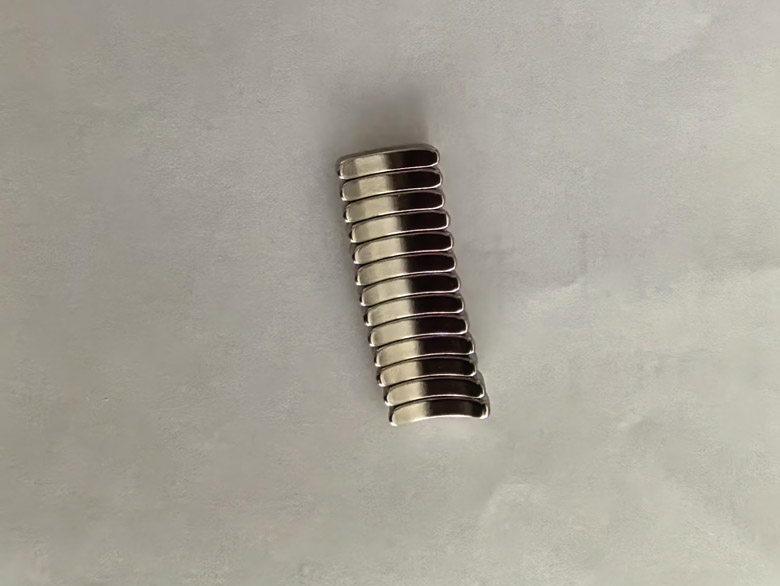
Segmented curved ndfeb magnets
The temperature coefficient of HcJ for neodymium-iron-boron is approximately −0.40 %/K to −0.65 %/K, whilst that for samarium-cobalt is approximately −0.17 %/K to −0.25 %/K. The greater the absolute value of the temperature coefficient, the more rapidly HcJ decreases as the temperature rises. Consequently, even if the HcJ of both materials is exactly the same at 20 °C, samarium-cobalt typically retains a higher HcJ at 150 °C or 200 °C.
To illustrate the trend, let us consider a simplified example: suppose that two types of magnet both have an HcJ of 1,600 kA/m at 20 °C, and the temperature coefficients of HcJ for neodymium-iron-boron and samarium-cobalt are estimated at −0.55 %/K and −0.20 %/K respectively. Upon heating to 150 °C, a linear approximation suggests that the HcJ of the neodymium-iron-boron magnet would be approximately 456 kA/m, whilst that of the samarium-cobalt magnet would be approximately 1184 kA/m. The actual results should be determined by the high-temperature demagnetisation curves for the corresponding grades; however, this example clearly illustrates that a common starting point at room temperature does not imply the same endpoint at high temperatures.
Recommended documents;