 China Neodymium And Ferrite Magnets Manufacturer & Supplier



In the motor industry, it is common to hear statements such as 60 magnet steel, 50 magnet steel, and 45 magnet steel. Many customers may wonder what the difference is between the two, and whether the larger the number, the better the performance? What do "60" and "50" represent here?
The numbers here usually represent the size series of magnetic steel, not simply the magnitude of magnetic force. Different motor designs will select magnetic steel of different specifications based on power, speed, and spatial structure.
The size of 60 magnet steel (Height 60mm) is relatively larger, which can provide a larger magnetic flux area. At the same material grade, it can help the motor obtain a stronger magnetic field and improve output torque. Of course, increasing the size of the magnet steel will also increase costs, and higher requirements will be placed on the rotor structure and installation accuracy.
Compared to other materials, 50 magnet steel (Height 50mm) is slightly smaller in size, lighter in weight, and easier to control in cost. In some small and medium-sized motors, 50 magnet steel can already meet the usage requirements.
Galvanised motor arc-shaped ndfeb magnets
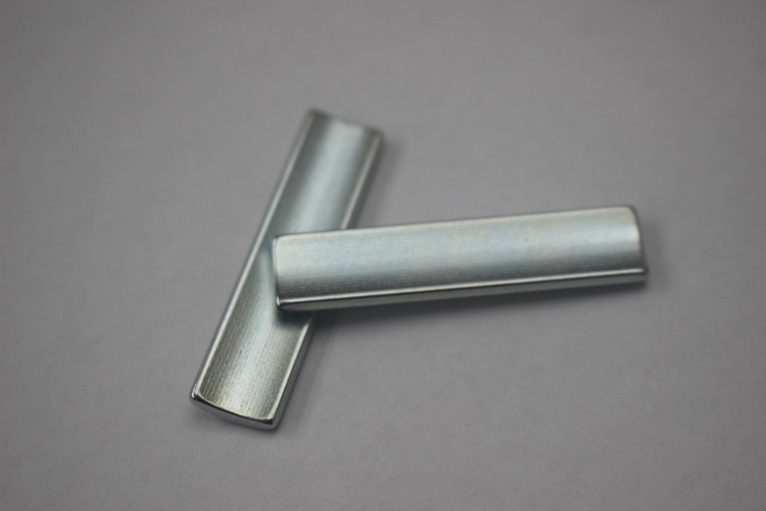
Generally speaking, the power of a motor mainly depends on the total area of the magnet. The rotor circumference of 12 inch and 13 inch motors is much larger than that of 10 inch motors. At the same power, in order to ensure that the overall magnetic steel area is close, the single magnetic steel of 12 inch and 13 inch motors will be made smaller than that of 10 inch motors. Meanwhile, due to the increase in rotor circumference, more magnets can be arranged to increase the number of magnetic poles, resulting in different electromagnetic designs for the motor.
After the number of magnetic poles increases, the corresponding electrical angular frequency of the motor during operation will be higher. With reasonable controller matching, it can usually bring smoother operation performance and higher efficiency in high-speed areas. This is also why many players have found that for motors of the same power, 12 inch and 13 inch motors often experience a more significant speed increase after overpressure operation than 10 inch motors. Of course, this also puts higher demands on the controller, battery power supply, and motor heat dissipation, and it is not necessarily faster just by changing to a larger size.
As for whether the 60-magnet or 50-magnet option is better, there is no definitive answer. If you are seeking greater torque and higher load capacity, you would typically opt for the larger magnet configuration. However, if cost, weight and value for money are your main priorities, the 50-magnet option is equally capable of meeting the requirements of many applications.
Related to motor magnets;