 China Neodymium And Ferrite Magnets Manufacturer & Supplier



When enquiring about magnetic ring products, many people tend to start by asking, ‘What materials are magnetic rings generally made of?’ In fact, the materials used vary depending on the intended application. The material of a magnetic ring is primarily determined by the operating environment and magnetic performance requirements. Currently, common types available on the market include ferrite, neodymium-iron-boron, samarium-cobalt, and composite injection-moulded magnetic rings (injection-moulded ferrite/injection-moulded neodymium-iron-boron), among which ferrite magnetic rings are by far the most widely used.
Ferrite magnetic rings can be divided into two main categories: permanent magnet ferrites and soft magnetic ferrites. Permanent magnet ferrites possess a fixed magnetic property and are commonly used in products such as motor rotors, multipole magnetic rings, speed-sensing magnetic rings and household appliance motors; they offer advantages such as low cost, corrosion resistance and resistance to demagnetisation. Soft magnetic ferrites, on the other hand, do not retain their magnetism over the long term and are primarily used in areas such as electromagnetic interference (EMI) suppression in electronic circuits, high-frequency transformers, inductors and filters.
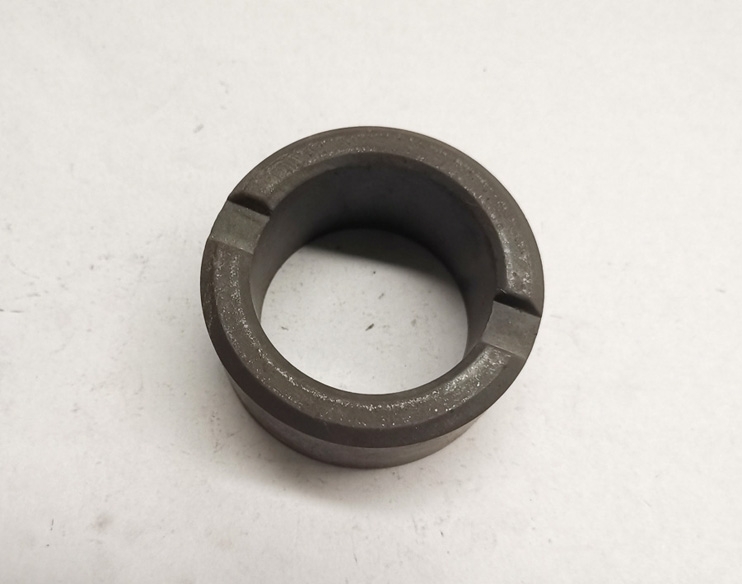
Ferrite magnetic ring with a notched positioning groove
Among soft magnetic ferrites, manganese-zinc ferrites and nickel-zinc ferrites are the most common. Manganese-zinc ferrites have high magnetic permeability and low loss, making them suitable for operating frequencies ranging from several kilohertz to several megahertz; they are therefore widely used in products such as switching power supply transformers, power adaptors, inductors and common-mode chokes. Nickel-zinc ferrites, on the other hand, possess a higher resistivity, which effectively reduces high-frequency eddy current losses, making them more suitable for applications at frequencies of tens of megahertz or higher. Consequently, they are commonly found in ferrite beads for data cables, USB cables, HDMI cables, network cables, power cables and various types of EMI suppression ferrite beads.
If a product requires a higher magnetic field strength, sintered neodymium-iron-boron magnetic rings are typically used. Neodymium-iron-boron is a high-performance permanent magnet material that offers a magnetic force far greater than that of ferrite for the same dimensions. Depending on the application’s requirements for magnetic performance, shape, structure and number of poles, one may also choose between injection-moulded and bonded neodymium-iron-boron magnetic rings.
There is no definitive ‘best’ or ‘worst’ material for magnetic rings; the key is to choose the right one based on your specific application requirements. If you have a specific material in mind for which you would like a quotation, or if you are unsure about the different materials available, please contact our customer service team for guidance.
Articles on ferrite magnetic rings;