 China Neodymium And Ferrite Magnets Manufacturer & Supplier



Motor magnetic steel is a key component in motors, and its installation status and performance directly affect the operational efficiency, stability, and service life of the motor. The following is a detailed analysis of the specific impacts of three common abnormalities: missing installation, reversed installation, and weak magnetism of magnetic steel.
Magnetic steel missing
Magnetic steel omission refers to the failure to install the requisite magnetic steel in the motor stator or rotor, resulting in a lack of magnetic field distribution.
If a magnet is missing from the motor, it will result in insufficient magnetic field strength and an unbalanced magnetic field distribution, as well as failure of the control system. This manifests as reduced output power and decreased efficiency; in severe cases, it may cause the motor to malfunction.
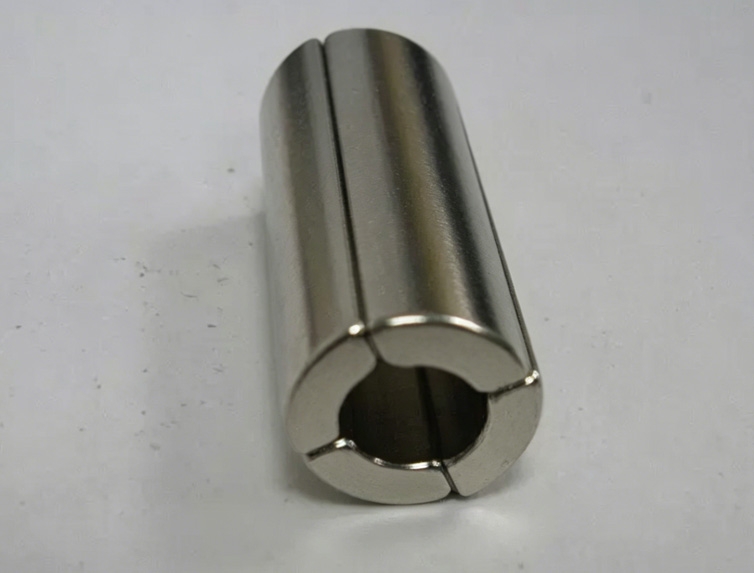
Arc-shaped neodymium rare-earth magnet
Magnet installed in reverse
Installing a magnet in reverse means that the N and S poles are oriented in the opposite direction from the design specifications, resulting in a reversed magnetic field polarity.
If the magnets are installed in the wrong orientation, this anomaly will cause magnetic field disruption and reverse the induced electromotive force, accompanied by severe vibration and abnormal noise. During motor startup, a “locked-rotor” condition is likely to occur, in which the rotor cannot rotate normally due to the internal magnetic fields canceling each other out or generating a reverse repulsive force. In permanent magnet synchronous motors, this can lead to a loss of synchronization between the stator and rotor magnetic fields, causing the system to fail. Prolonged operation may also result in loosening or fracture of mechanical components, abnormal noise frequencies, and potentially sharp electromagnetic noise.
Weak magnetic field
Weak magnetism refers to a situation where the remanence (Br) or coercivity (Hc) of a magnet falls below the design specifications, or where materials that meet the specifications exhibit aging, demagnetization due to high temperatures, or manufacturing defects.
If the magnetism of the permanent magnets weakens, the motor’s output torque will decrease, resulting in poor performance under load. In addition, weakened magnetism can increase the motor’s thermal load, potentially causing overheating, which further affects the motor’s stability and service life.
Introduction to related motor magnets;
3 Key Inspection Items for Motor Magnets