 China Neodymium And Ferrite Magnets Manufacturer & Supplier



The magnet in a speedometer is one of the core components responsible for detecting and indicating vehicle speed; its role is indispensable, particularly in traditional mechanical or certain electronic instrument clusters. This article will focus on the function, materials, and shape of speedometer magnets.
In traditional mechanical speedometers, a magnet is typically mounted on the input shaft, rotating in sync with the wheels or the transmission. As the magnet rotates, it generates a changing magnetic field around it, which induces eddy currents in an aluminum rotor (i.e., the electromagnetic induction effect). These eddy currents cause the pointer to deflect, thereby indicating the vehicle's speed.
In modern electronic speedometers, magnets are typically used in conjunction with Hall effect sensors or magnetoresistive sensors; changes in the magnetic field trigger pulse signals, which the ECU then uses to calculate vehicle speed. Therefore, whether in mechanical or electronic systems, magnets perform the critical function of converting “mechanical motion → electrical signals/pointer movement.”
Working principle of speedometer magnet
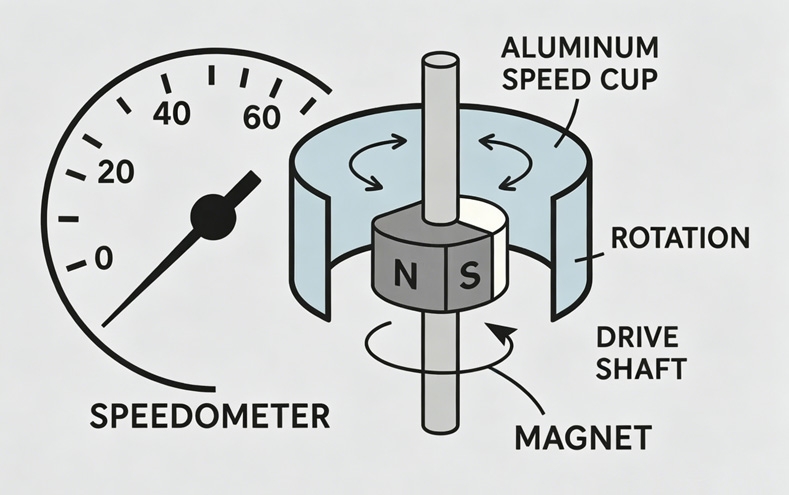
The choice of material for speedometer magnets primarily depends on accuracy requirements, cost considerations, and the operating environment. Common materials include sintered ferrite, sintered neodymium-iron-boron, samarium-cobalt, and injection-molded magnets, such as injection-molded ferrite.
As for shape, speedometer magnets come in various forms, designed according to installation methods and magnetic field requirements. The primary shapes are circular, cylindrical, and ring-shaped.
In electronic speed measurement systems, multi-pole magnetic rings are commonly used; by alternating N/S pole arrangements, they enable high-resolution speed measurement. In mechanical structures, however, single-pole or simple-structure magnets are sufficient to meet requirements.
The above provides an overview of speedometer magnets. If you have specific dimensional requirements or detailed drawings, please feel free to contact us.
Related speed-measuring magnet products;
Speed regulating motor 16 pole ferrite ring 21.7 x 7.9 x 5.1 mm