 China Neodymium And Ferrite Magnets Manufacturer & Supplier



As the core magnetic component of an electric motor, the performance of motor magnets not only affects the motor’s efficiency, speed, and output torque, but also impacts the overall stability and service life of the motor. Therefore, it is essential to inspect motor magnets before use. So, what are the most important inspection items for motor magnets?
First is high-temperature stability testing. Many motors operate for extended periods in environments characterized by high temperatures, high rotational speeds, and alternating magnetic fields. If the magnetic steel lacks sufficient heat resistance, it is prone to magnetic decay or even irreversible demagnetization, leading to a decrease in motor power and efficiency. Therefore, high-temperature stability testing is a critical component of motor magnet evaluation and typically includes: open-circuit magnetic decay testing, semi-open-circuit magnetic decay testing, high-temperature demagnetization curve testing, and long-term aging stability testing. Applications such as new energy vehicle drive motors and high-speed motors place particularly high demands on the high-temperature stability of magnets, requiring more rigorous temperature resistance verification to ensure that stable magnetic performance is maintained during long-term operation.
The accompanying image shows an arc-shaped segmented permanent magnet for electric motors.
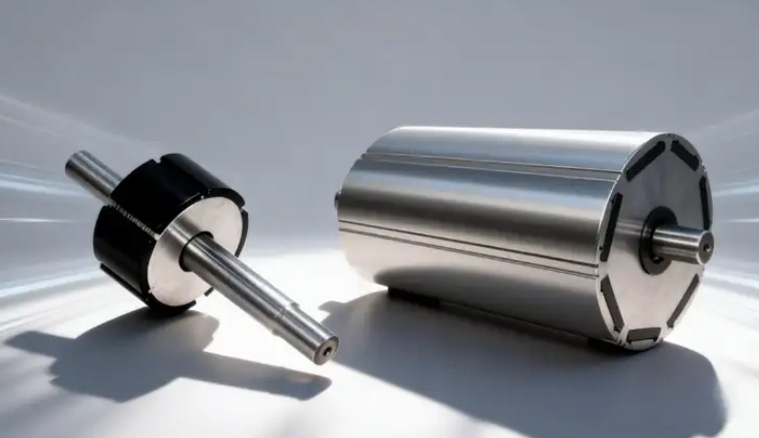
Another key factor is magnetic flux uniformity testing. It is not enough for motor magnets to simply “have magnetic force”; what is even more critical is the uniformity of the magnetic flux between each magnet. If the magnetic flux deviation is too large, it can easily lead to increased motor vibration, increased noise, torque fluctuations, insufficient output, and reduced motor efficiency. The industry typically requires magnetic flux deviation to be controlled within 5%, while high-precision servo motors, drone motors, and high-speed motors demand even higher consistency, often requiring it to be maintained around 2%–3%. To achieve stable consistency, manufacturers typically control residual magnetism consistency, dimensional tolerances, chamfer dimensions, magnetization direction, and material batch consistency.
Finally, there is assembly compatibility. For products such as curved magnets and multi-pole ring magnets, simply meeting dimensional specifications is not enough; actual assembly fit is equally important. For example, issues such as the accuracy of curvature, consistency of angles, uniformity of joint gaps, and the presence of interference after assembly all directly impact motor assembly efficiency and final performance. Therefore, many professional magnet manufacturers use specialized contouring jigs to simulate the customer’s actual assembly conditions and conduct pre-assembly testing on the magnets. This verifies the product’s compatibility and interchangeability, thereby reducing subsequent assembly issues for the customer.
The above outlines the three key inspection items for motor magnets. If your company is interested in obtaining a quote or samples of motor magnets (arc-shaped or multi-pole ring-shaped), please feel free to contact us using the contact information provided on our website.
The related content has received many clicks;
Popular Questions Related to Motor Magnet Grades
Is more magnets better in brushless motors?
Signs and Prevention of Magnet Detachment in Brushless Motors