 China Neodymium And Ferrite Magnets Manufacturer & Supplier



In brushless motors (BLDC or PMSM), the number of permanent magnets is often regarded as a key factor affecting performance. Many users believe that more magnets make the motor stronger and therefore better, but is this really the case?
In brushless motors, “more magnets” primarily refers to an increase in the number of magnetic poles (i.e., the quantity of magnets). When more magnetic poles are present, the motor's commutation frequency increases, torque ripple decreases, and operation becomes smoother. This significantly improves performance, particularly in low-speed applications or those requiring precise control. However, this is merely one method of enhancing performance and does not imply that adding more magnetic poles is suitable for all motors.
The greater the number of magnetic poles, the more magnets or more complex multipole magnetization is required, leading to a significant increase in manufacturing costs. Simultaneously, assembly complexity, calibration requirements, and controller performance demands rise, driving up the cost of drive chips and MCUs. Therefore, for price-sensitive products like fans, small pumps, and power tools, manufacturers will not blindly add magnetic poles merely to achieve marginal performance gains.
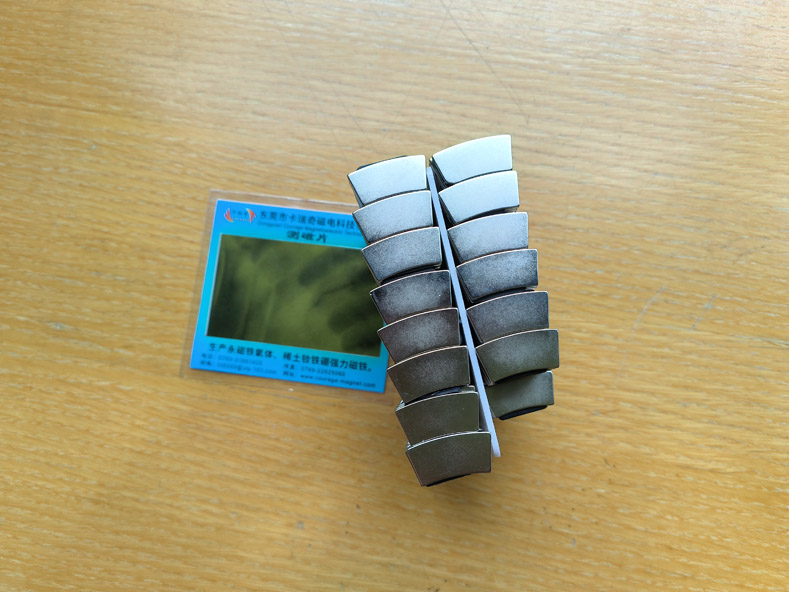
Illustration shows segmented curved neodymium magnets for brushless motors.
While multi-pole designs offer advantages such as high low-speed torque, reduced noise, and smoother operation, they increase iron losses and eddy current losses at high speeds. This limits maximum rotational speed and reduces efficiency. Therefore, high-speed motors like those in drones, vacuum cleaners, and electric toothbrushes are better suited for lower pole numbers. Conversely, robot joints, gimbals, and stepper motor replacement applications favor multi-pole designs.
The number of magnets is merely one design parameter. The optimal solution is typically determined by motor engineers through comprehensive magnetic circuit calculations, simulations, and slot-pole ratios. A general rule is: fewer poles for high speeds, medium poles for medium speeds and high torque, and more poles for low speeds and smooth control. Each motor type has its own “optimal pole range.” Having more magnets is just one option, not the sole criterion for evaluating quality.
Therefore, brushless motors do not follow the principle of “more magnets, better performance.” Instead, the optimal solution lies in identifying the pole count that offers the highest cost-performance ratio.
Articles on magnets for brushless motors;
Signs and Prevention of Magnet Detachment in Brushless Motors