 China Neodymium And Ferrite Magnets Manufacturer & Supplier



In motor, magnetic encoder, and new energy vehicle sensing systems, Hall effect magnetic rings are typically installed on rotating shafts to work with Hall sensors for speed or position detection. So in practical design, should the inner diameter of the magnetic ring and the shaft use clearance fit or interference fit?
Firstly, from the perspective of installation stability, most Hall magnetic rings adopt a slight interference fit. Magnetic rings in motors or sensing systems usually rotate at high speeds along with the shaft. If a large clearance is used, they may loosen, slip, or shift in position during long-term operation, resulting in unstable detection signals from Hall sensors. Using an appropriate interference fit (e.g. around 0.01mm~0.03mm) can ensure that the magnetic ring is firmly fixed on the shaft and will not rotate or slide.
Secondly, some materials or structures of magnetic rings may also use gap fit and be fixed with glue. For example, bonded neodymium iron boron magnetic rings and sintered ferrite magnetic rings, due to their relatively brittle materials, may crack or even break during press fitting if the interference fit is too large. Therefore, in some product designs, gap fitting and structural adhesive bonding are used to ensure positioning accuracy and reduce assembly risks.
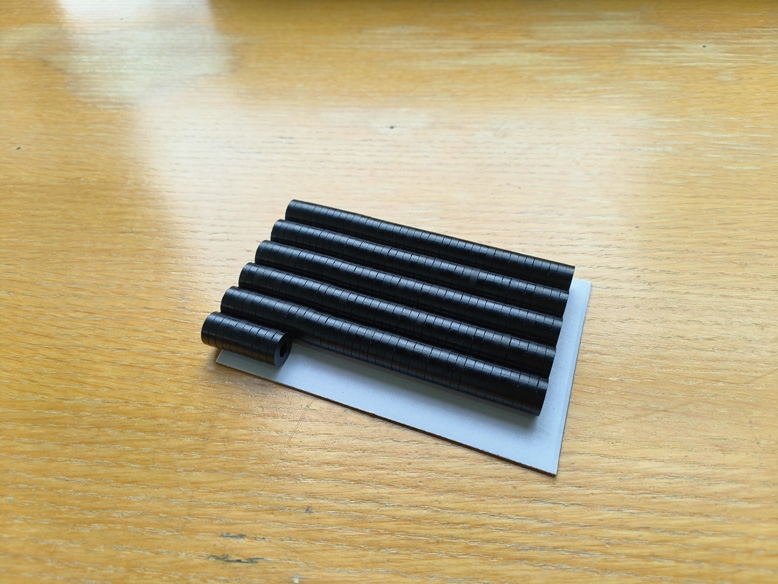
The accompanying image shows bonded neodymium magnetic ring
In addition, in high-precision position detection applications, assembly coaxiality is also crucial. There is usually only a small air gap between the Hall induction magnetic ring and the sensor. Improper assembly can cause the magnetic ring to become eccentric, which can affect the magnetic field distribution and cause fluctuations in the detection signal. Therefore, when designing the fitting method, it is necessary to comprehensively consider factors such as shaft diameter tolerance, magnetic ring material, assembly process, and speed requirements.
So, there is no absolute unified standard for the inner diameter matching method of Hall induction magnetic rings. Reasonable coordination design can not only ensure stable operation of the magnetic ring, but also improve the reliability and service life of the Hall detection system.
Other Hall effect magnet related;
What Is A Motor Hall Sensor Magnetic Ring?