 China Neodymium And Ferrite Magnets Manufacturer & Supplier



The recent sharp fluctuations in international rare earth prices stem primarily from the combined resonance of multiple factors including policy, supply and demand dynamics, market mechanisms, and costs.
First, geopolitical tensions and policy interventions are the primary drivers of this round of volatility. China's implementation of export controls on medium-heavy rare earths like dysprosium and terbium starting in 2024, coupled with intensified crackdowns on smuggling of strategic minerals, has significantly reduced available resources in overseas markets. The decline in exports combined with tighter enforcement has directly driven substantial price increases for overseas dysprosium oxide, terbium oxide, and other varieties, creating temporary supply shortages and price surges.
Second, structural supply-demand imbalances further amplified price elasticity. On the supply side, global rare earth smelting and separation capacity remains highly concentrated, with China retaining dominance. Overseas projects in the US, Australia, and elsewhere progress slowly—for instance, a significant proportion of oxides from MP Materials' Mountain Pass mine still relies on Chinese processing. Simultaneously, temporary disruptions in Myanmar ore imports and the ongoing implementation of China's total volume control policies for domestic mining and smelting have tightened supplies of medium-to-heavy rare earths. On the demand side, driven by the new energy vehicle, wind power, and industrial robotics industries, the consumption of high-performance neodymium-iron-boron permanent magnets continues to grow. Combined with strategic reserve demands from defense and high-end electronics sectors, the supply-demand gap is expected to widen.
Reasons for Fluctuations in International Rare Earth Prices
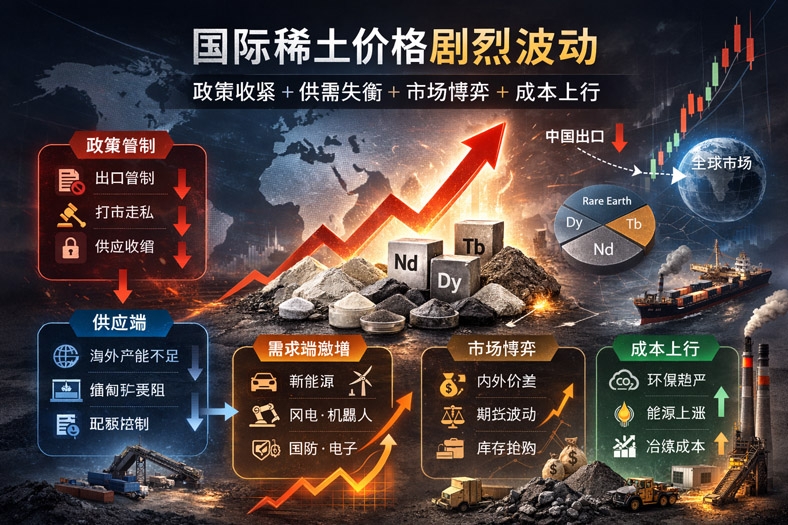
Third, heightened market mechanisms and financial attributes amplify volatility. Significant price differentials exist domestically and internationally, prompting overseas manufacturers to increase safety stock levels to mitigate supply chain risks. For instance, the U.S. Department of Defense signed a long-term procurement agreement with MP Materials, setting a price floor for praseodymium-neodymium, thereby strengthening support for higher overseas price ranges. Concurrently, traders' reluctance to sell and profit-sharing behaviors, combined with divergences between futures and spot prices, have amplified short-term market fluctuations.
Finally, environmental and cost factors form a bottom support. Tightening domestic environmental policies, rising energy prices, and the high energy consumption of the smelting and separation process have increased rare earth production costs. When supply contraction coincides with cost increases, price upward elasticity significantly strengthens.
In summary, the current international rare earth price volatility stems not from a single event but from the combined effects of policy tightening, global supply-demand mismatches, financial speculation, and rising costs. High volatility will persist in the short term, while medium-to-long-term trends will depend on the pace of overseas capacity expansion and policy directions.
Articles on neodymium magnet material pricing;
Feb 2025 – Feb 2026 Praseodymium Neodymium Metal Price Trend Chart