 China Neodymium And Ferrite Magnets Manufacturer & Supplier



In absolute or incremental magnetic encoders, dual-track (dual-channel) magnetic rings are widely used in motor control, robotic joints, and precision servo systems because they can provide both position and orientation information simultaneously. However, during the actual selection and application process, customers often encounter technical issues. Below is a summary of some typical problems.
Q1. What is a dual-track encoder ring magnet?
A dual-track encoder ring typically refers to a single magnet that features two magnetic encoding tracks (inner and outer rings), each used for different signal outputs. For example, one ring is used for primary position detection, while the other is used for direction identification or a zero-position signal. These rings are often made of injection-molded ferrite, bonded neodymium-iron-boron, or rubber magnetic materials, with a multi-pole distribution achieved through precision magnetization.
Q2. How many magnetic poles correspond to one pulse?
One pulse corresponds to two magnetic poles. This is the basic principle by which the sensor chip detects and counts magnetic fields to determine position.
Q3. What is the operating temperature range for dual-track encoder disc magnets?
It depends on the magnet material; for commonly used rubber ferrites, it is generally -20°C to 120°C.
Bonded neodymium material encoder with dual-track magnetic rings
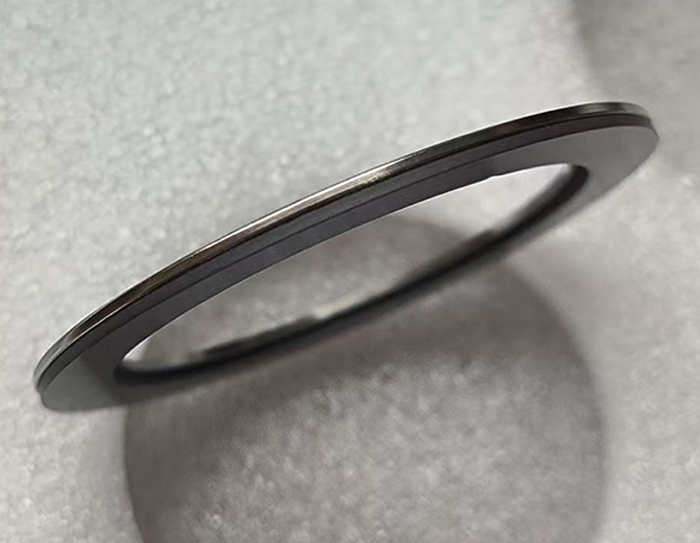
Q4. What is the magnetization method for the encoder’s magnetic ring?
Axial multipole magnetization. This is a precision process that uses pulse technology to magnetize each pole sequentially.
Q5. Why does accuracy decrease after installing the magnetic ring?
This may be due to eccentric or tilted installation, resulting in inconsistent gaps between the magnetic ring and the sensor. Ensure coaxiality (generally ≤0.05 mm) and maintain a stable air gap (e.g., within the range of 0.5–1.5 mm).
Q6. How do I select the appropriate number of pole pairs?
The higher the number of pole pairs, the higher the resolution; however, this also places greater demands on installation accuracy and sensor bandwidth. For low-speed, high-precision applications (e.g., robotic arm joints), 32–64 pole pairs are recommended. For medium-speed, general-purpose applications (e.g., industrial servos), 16–32 pole pairs are recommended. For high-speed applications (e.g., spindle motors), 8–16 pole pairs are recommended to prevent the sensor from failing to keep up with the response.
Q7. Do you have the specifications I need?
Not necessarily. For specific requirements regarding specifications, materials, and magnetic poles, please search our website or contact us via WeChat or Email.
Popular dual-track encoder magnetic rings;
2 Track multipole 62 64 poles axial encoder disk 29x15x1.1mm
Robot Encoder Dual-Channel Magnetic Ring 56x38x1.1mm
Rotary magnetic encoder ring magnet 34x18x4.95mm 520 gauss
128 poles and 126-poles multipole magnetic encoder ring magnets