 China Neodymium And Ferrite Magnets Manufacturer & Supplier



Magnetic encoder disk is a key component that uses changes in magnetic fields to detect position or angle, and is widely used in motor control, automation equipment, robotics, and smart home appliances. It is typically used in conjunction with Hall sensors or magnetoresistive sensors to accurately measure rotational speed, position, or angle by detecting changes in magnetic polarity. Compared to traditional optical encoders, magnetic encoder disks offer advantages such as resistance to dust, oil, and vibration, making them increasingly popular in industrial environments and home appliances.
The operating principle of a magnetic encoder disk is not complicated, but its precision is critical. Encoder disks are typically made of multi-pole magnetized permanent magnet materials; as they rotate with the shaft, a periodically varying magnetic field is generated on their surface. An array of Hall-effect sensors or magnetoresistive sensors mounted on the opposite side captures these magnetic field changes in real time. After processing by a signal processing chip, the absolute angle or relative rotational speed of the shaft can be determined. The number of pole pairs on the disk determines the system’s resolution—the more pole pairs there are, the denser the signal cycle per revolution, and the higher the angular resolution. Taking a common 16-pole-pair encoder disk as an example, when paired with a high-precision chip, the angular resolution can easily reach 14 bits or higher, meeting the requirements of the vast majority of industrial servo and robotics applications.
Currently, the commonly used materials on the market primarily include bonded NdFeB, injection-molded ferrite, and rubber magnets. These materials feature a ring-shaped structure with uniformly distributed magnetic poles along the circumference, which can be designed as 8-pole, 16-pole, 32-pole, 64-pole, or even more poles (up to 128 poles) to meet varying resolution requirements. Among them, bonded NdFeB offers superior magnetic performance, making it suitable for high-precision detection, while injection-molded ferrite is characterized by low cost, corrosion resistance, and excellent dimensional stability, thus being widely used in household appliances and consumer electronics.
Magnetic Encoder Disk, 126 poles on the inner ring, 128 poles on the outer ring
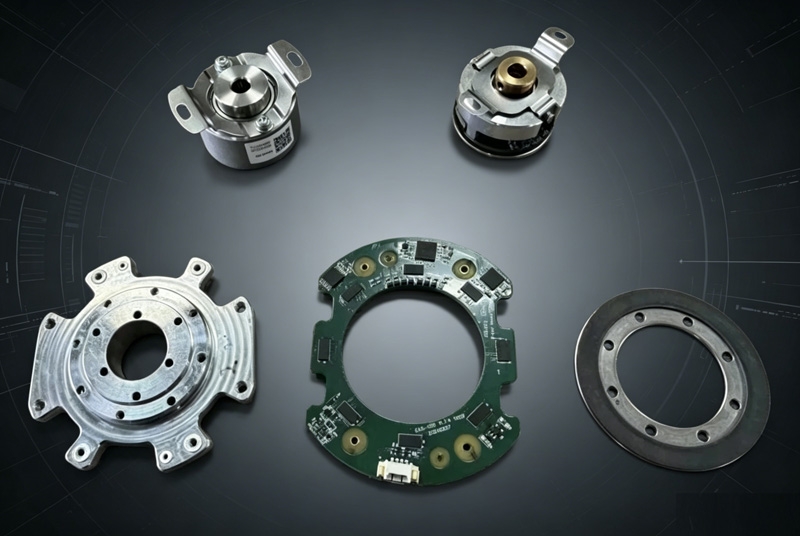
In practical applications, magnetic encoder discs are typically mounted on the shaft or rotor of a motor. As the motor rotates, the disc generates periodic changes in the magnetic field. The sensor reads these magnetic signals to calculate the motor’s rotational speed and angular position. For example, in robotic vacuum cleaners, brushless motors, servo motors, and robotic joints, magnetic encoder discs are critical components for achieving precise control. By optimizing the number of magnetic poles and the distribution of the magnetic field, the measurement accuracy and stability of the system can be effectively improved.
We currently stock a wide range of dual-track magnetic encoder discs in various sizes (in stock) at competitive prices. Please feel free to contact us for samples and quotes.
Selecting magnetic encoder disk;
Robot Encoder Dual-Channel Magnetic Ring 56x38x1.1mm
Encoder single-sided multipole ferrite ring magnet 34mm x 2.5mm
Multipole double coil rubber magnetic ring for encoder D49x25x2mm
Related content;