 China Neodymium And Ferrite Magnets Manufacturer & Supplier



As the robotics industry evolves toward greater intelligence, lighter weight, and higher precision, motor and sensor systems are placing increasingly stringent demands on magnetic materials. Injection-molded ferrite magnetic materials (plastic-ferrite) are gradually finding widespread application in core robot components due to their advantages, including the ability to be formed into complex shapes, multi-pole magnetization, high consistency, and controllable costs.
Robots place extremely high demands on the stability and response speed of their drive systems. In robot servo motors and reduction motors, injection-molded ferrites can be used for rotor magnetic rings or integrated rotor structures. Their one-piece molding characteristic effectively prevents the eccentricity and detachment issues caused by joining magnetic steel pieces, thereby improving motor operational stability. Additionally, in the outer rotor structures of robot motors, injection-molded magnetic rings enable high-concentricity designs, which help reduce vibration and noise, making them particularly suitable for applications such as collaborative robots and service robots.
In precision control systems such as robotic actuators and 3-axis balancing motor rotors, the multi-pole magnetization capability of injection-molded ferrites is particularly critical. The injection molding process enables the design of 8-pole, 12-pole, or even higher-pole configurations, endowing the motor with higher resolution and smoother output characteristics. This is of significant importance for applications such as robotic joint control and posture adjustment, as it can significantly enhance control accuracy and dynamic response performance.
8-pole injection-molded ferrite ring
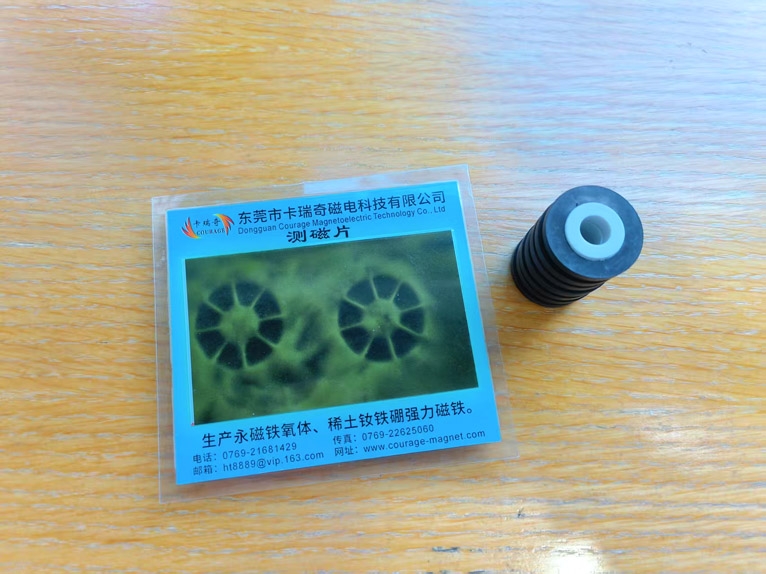
Injection-molded ferrite materials are also widely used in robot stepper motor rotors. Compared to traditional laminated or sintered magnet structures, injection-molded magnetic rotors offer superior dimensional consistency and magnetic field distribution, facilitating more precise stepper control. Additionally, their lower manufacturing costs make them a cost-effective choice for educational robots and small-scale automation equipment.
Robotic systems rely on precise position feedback. In applications such as robot Hall sensors and sensing systems for cleaning robots, injection-molded ferrites enable high-precision magnetic encoding structures. With their uniform pole distribution, they can work in conjunction with Hall elements and magnetic encoders to achieve precise detection of angle, speed, and position, providing reliable data support for closed-loop control systems.
The above outlines the typical applications of injection-molded ferrites in robotics. If you are looking for samples or wish to request a quote, please feel free to contact us via the contact information provided on our website.
Other related articles;
Magnetic Applications in Humanoid Robots
Sintered Ferrite Magnets VS Injection Molded Ferrite Magnets