 China Neodymium And Ferrite Magnets Manufacturer & Supplier



When selecting neodymium magnets, the magnetic performance grade (such as N35, N45, or N52) is one of the key parameters that determine their actual performance. Taking a commonly used cylindrical magnet (10 × 10 mm) as an example, different grades exhibit significant differences in surface magnetic field strength (in Gauss) and holding force, which provides important reference information for product design and application matching.
First, let’s look at N35 grade. This grade represents a more basic level of neodymium-iron-boron performance; a 10×10 mm cylindrical magnet of this grade has a surface magnetic field of approximately 4,500 gauss, corresponding to a holding force of about 1.5 kg. The advantage of N35 lies in its high cost-effectiveness.
Next is the N45 grade, which offers a significant performance improvement over the N35 grade. For the same dimensions, the surface magnetic field of an N45 cylindrical magnet can reach approximately 5,300 Gauss, with a holding force of about 1.8 kg. This grade provides stronger magnetic holding power while keeping costs under control, making it widely used in motor components, magnetic coupling systems, and certain industrial equipment. It represents a mid-to-high-end option that balances cost-effectiveness with performance.
Neodymium Cylinder Magnets 10x10mm
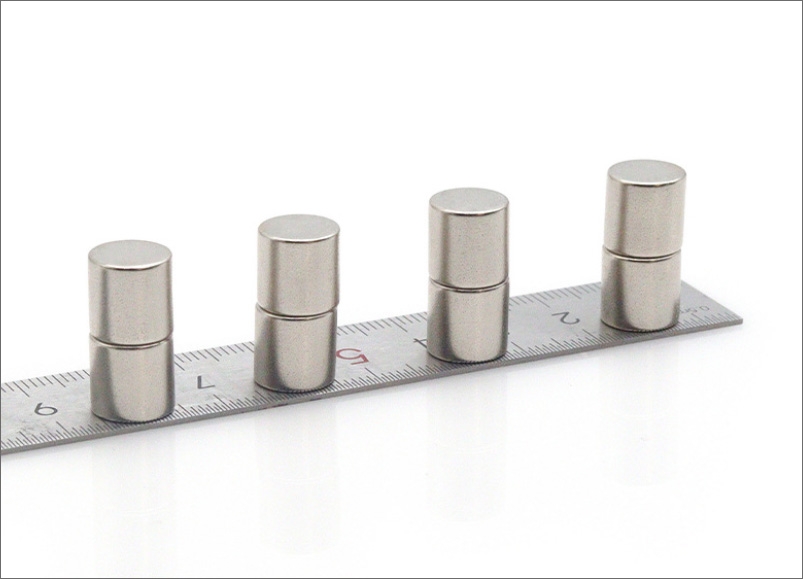
Now let’s look at the N52 grade, which is currently one of the higher-performance grades among mass-produced neodymium magnets. 10x10mm N52 magnet has a surface magnetic field of approximately 5,550 Gauss and a holding force of about 1.9 kg. Compared to N45, the improvement in performance has leveled off, but it still offers irreplaceable advantages in precision equipment or high-end motors that demand extremely high magnetic performance. However, it is important to note that N52 is more expensive and more sensitive to temperature fluctuations.
Overall, from N35 to N52, the magnetic flux density and holding force of the magnets show an increasing trend, but the rate of increase gradually slows down. This means that when selecting a magnet, a higher grade is not necessarily better; instead, a reasonable choice should be made based on the product’s magnetic requirements, cost budget, and operating environment (such as temperature and space constraints).
You might also like;
10x2mm N28 vs N45 Round Neodymium Magnets Gauss and Pull Force