 China Neodymium And Ferrite Magnets Manufacturer & Supplier



Over the years of working with magnets, we have occasionally received questions from customers about converting Gauss to pull force. For example, they want to know how much pull force a 2000 Gauss magnet has, or how many kilograms of pull force a 3100 Gauss magnet has. Below, we will try to explain this in easy-to-understand language.
Let's first look at the definitions of Gauss and traction.
Gauss represents magnetic field strength, with units of G or mT (1T = 10,000 G). A common measurement is the surface magnetic induction intensity (surface field) at the center of the magnet's surface.
Pull force refers to the maximum vertical adhesive force with which a magnet attracts a piece of iron or another magnetic object, with units typically expressed in newtons (N) or kilograms (kgf).
Magnetic flux density ≠ magnetic force
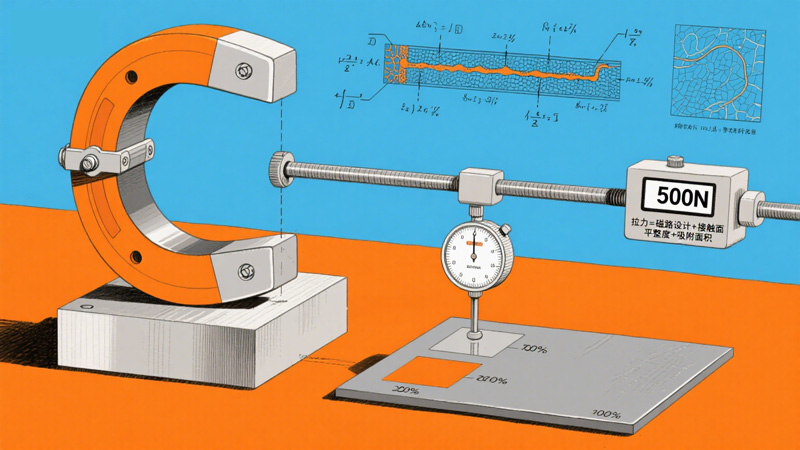
As can be seen from the definition, gauss and kilogram cannot be directly converted.
Gauss refers to the local magnetic field strength, while the pulling force is the result of multiple factors, including the overall magnetic circuit, contact surface, and adsorption area. Magnets with the same Gauss value can have significantly different pulling forces depending on their size, the object they are in contact with, and the adsorption method.
Some websites may introduce certain formulas, but the actual error margin can be quite large because the measured Gauss value differs significantly from the actual magnetic field strength.
Therefore, to obtain pull force data, it is recommended to use the tensile force test values provided by the manufacturer or actual measurements.
Related articles;