 China Neodymium And Ferrite Magnets Manufacturer & Supplier



The rotor magnetic ring for flow sensors is an essential magnetic component in water heaters—including wall-mounted boilers—and water purifiers. Today, we will focus on introducing its primary functions, operating principles, and material selection. If you need samples or a quote, please contact NST.
First, let’s discuss its function: the magnetic ring in a water flow sensor is primarily used to convert the mechanical motion generated by water flow into an electrical signal. When water flow drives the impeller to rotate, the magnetic ring rotates with it; its periodically changing multipole magnetic field is detected by a Hall effect sensor, which then outputs a pulse signal. By calculating the pulse frequency, the control circuit accurately measures water flow velocity or flow rate, making the magnetic ring the core component responsible for signal acquisition in the entire sensor.
Water Flow Sensing Magnetic Rotor
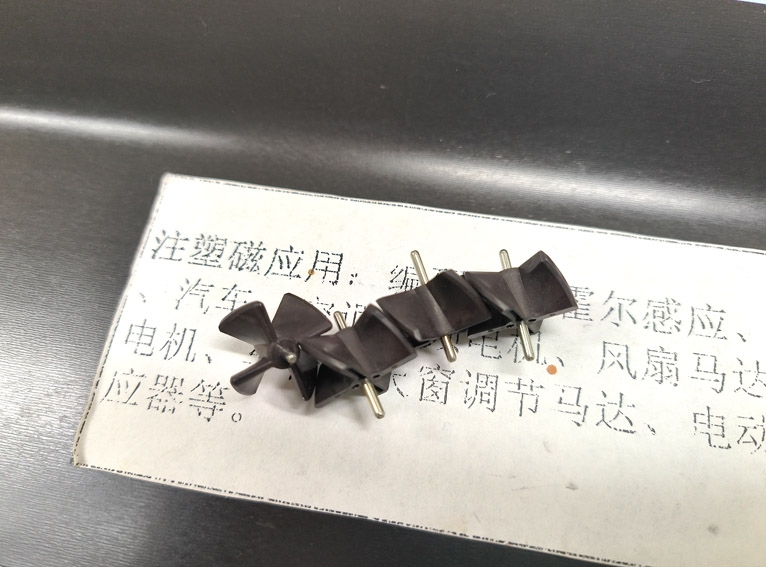
Its operating principle is based on changes in the magnetic field and Hall effect detection. When water flows through the sensor, it drives the internal impeller to rotate; the magnetic ring embedded in the impeller rotates in sync. The surface of the magnetic ring is typically magnetized into a 2-pole or 4-pole configuration, causing the direction and intensity of the surrounding magnetic field to change periodically during rotation. A Hall sensor installed near the magnetic ring continuously detects these magnetic field changes, outputting an electrical pulse signal each time the magnetic polarity switches. As the water flow velocity changes, the impeller’s rotational speed changes accordingly, and the rotational frequency of the magnetic ring also changes, causing the output pulse frequency to be directly proportional to the water flow velocity. Ultimately, the control circuit calculates the instantaneous flow velocity or cumulative flow rate by counting the pulse signals and analyzing their frequency.
As for material selection, injection-molded ferrite is the mainstream solution for flow sensor magnetic rings. This material offers advantages such as low cost, corrosion resistance, and high water resistance. Furthermore, the injection molding process allows for the integration of magnetic and structural components into a single unit, significantly improving product consistency and assembly efficiency.
The above is an introduction to the article title. Our company offers a wide range of specifications suitable for Hall water flow sensors, as well as support for pole numbers and material customization.
Selection of related products;
Radial 10 pole water flowmeter sensor induction rotor magnet