 China Neodymium And Ferrite Magnets Manufacturer & Supplier




When selecting magnets, some internet users have raised the question: given that both are circular discs with a diameter of 20 mm and a thickness of 2 mm, and both have been aged at the same temperature, why is the flux loss of N52 actually greater than that of N35? Isn’t N52 supposed to be superior?
This question is very typical. We are accustomed to understanding N35, N45, and N52 as "performance levels" that are stronger than each other, but we overlook that the brand number mainly describes the magnetic energy product and does not directly represent the anti demagnetization ability.
Where is N52 strong? It is strong in magnetic energy product, not coercive force. The key indicator that determines whether a magnet can "maintain its magnetization state" under high temperature and reverse magnetic field is its intrinsic coercivity.
For example, at room temperature, the lower limit for N35 Hcj is typically around 955 kA/m, whilst for N52 it is around 876 kA/m.
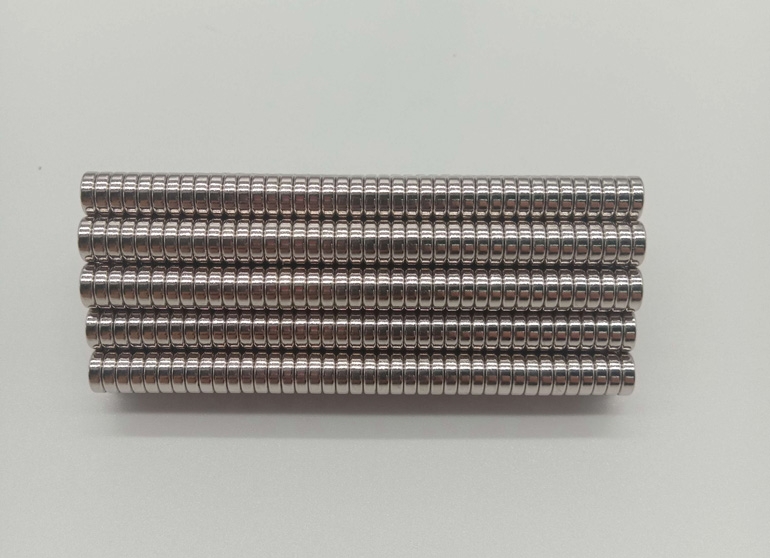
N35 disc magnets
Therefore, the N52 is not a comprehensive upgrade of the N35 across all metrics. It is more a case of increasing the ‘output capacity’, which does not necessarily mean that the ‘interference resistance margin’ has increased accordingly.
As neodymium-iron-boron heats up, its residual magnetisation decreases and its intrinsic coercivity also drops significantly; consequently, the inflection point of the demagnetisation curve shifts towards a lower reverse magnetic field.
At a certain temperature, the operating point of standard N52 may have already entered the inflection zone, with some magnetic domains beginning to reverse; standard N35, however, due to its relatively high coercive force reserve, may still have its operating point within a relatively stable region. Consequently, for the same dimensions, temperature and holding time, the irreversible flux loss in N52 is actually greater.