 China Neodymium And Ferrite Magnets Manufacturer & Supplier




Magnetic rings mounted on motor shafts are typically used for applications such as motor position detection, speed feedback, angle recognition and Hall sensor signal acquisition. Depending on the motor’s structure and operational requirements, magnetic rings vary in terms of material, dimensions, magnetisation method and number of magnetic poles. Below is a summary of the six questions customers are most frequently concerned about when purchasing or customising magnetic rings for motor shafts.
1. What is the main function of the magnetic ring on the motor shaft?
It is primarily used for detecting magnetic signals. For example, the rotating magnetic ring generates a periodically varying magnetic field which, when used in conjunction with components such as Hall sensors and magnetic encoders, enables the detection of the motor’s speed, direction of rotation and rotor position.
2. What magnetic materials are generally used for motor shaft magnetic rings?
Common materials include injection-moulded ferrite, sintered ferrite, bonded neodymium-iron-boron and injection-moulded neodymium-iron-boron, amongst others.
3. How many poles can the magnetic ring on the motor shaft have?
Depending on actual requirements, it can be designed with 2, 4, 6, 8, 12, 16, 24 or even more poles.
Magnetic rings on motor shafts – injection-moulded ferrite material
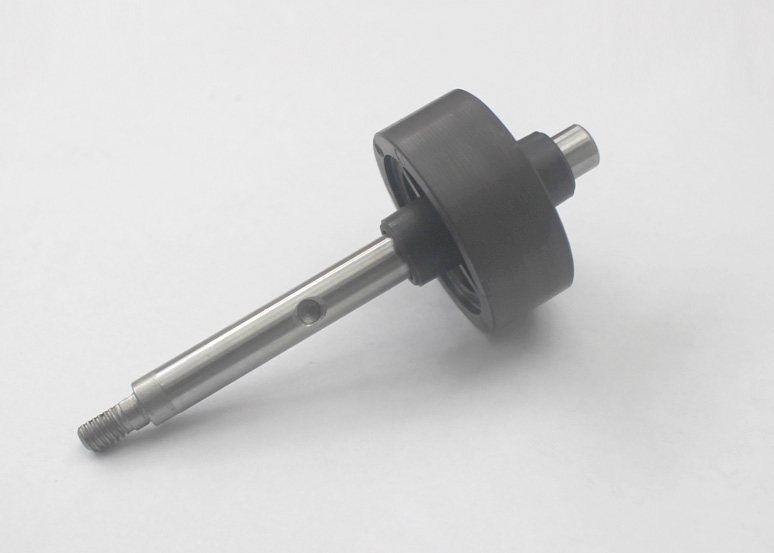
4. What are the different magnetisation methods for motor shaft magnetic rings?
Common magnetisation methods include radial magnetisation (the most common), axial magnetisation and multipole magnetisation (which can be at an oblique angle), amongst others.
5. Can the inner bore dimensions of motor shaft magnetic rings be customised?
Certainly. For some D-shaped shafts, the inner bore of the magnetic ring may need to be shaped like the letter ‘D’—this is no problem, provided the tolerances are confirmed at the time of customisation.
6. What causes magnetic field non-uniformity in motor shaft magnetic rings?
This may be related to the properties of the magnetic material, the dimensional accuracy of the product, the magnetisation mould, and the inspection methods used.
Although magnetic rings on motor shafts are small in size, they have certain requirements regarding dimensional accuracy, magnetic pole distribution and magnetic field stability. If you require magnetic rings of this type, please feel free to contact Carichi for a quotation and samples.
Highly related articles;