 China Neodymium And Ferrite Magnets Manufacturer & Supplier



In the design of permanent magnet motors, the number of magnetic poles (usually expressed as ‘number of poles’ or ‘number of pole pairs’) is a parameter that appears simple but is in fact extremely critical. It not only determines the motor’s speed range, but also affects a number of factors, including torque output, efficiency, dimensions, noise levels, control complexity and manufacturing costs.
In terms of speed and torque, the number of magnetic poles is inversely proportional to the motor’s maximum speed. At the same drive frequency, the fewer the number of magnetic poles, the higher the speed the motor can achieve; consequently, products such as high-speed fans, vacuum cleaners and spindle motors typically employ a smaller number of magnetic poles. Conversely, as the number of magnetic poles increases, the magnetic field contributing to work per unit angle of rotation becomes stronger, resulting in greater low-speed torque and smoother operation. This makes them particularly suitable for applications requiring high torque output, such as hub motors, robotic joints and servo motors.
Magnets for permanent magnet motors
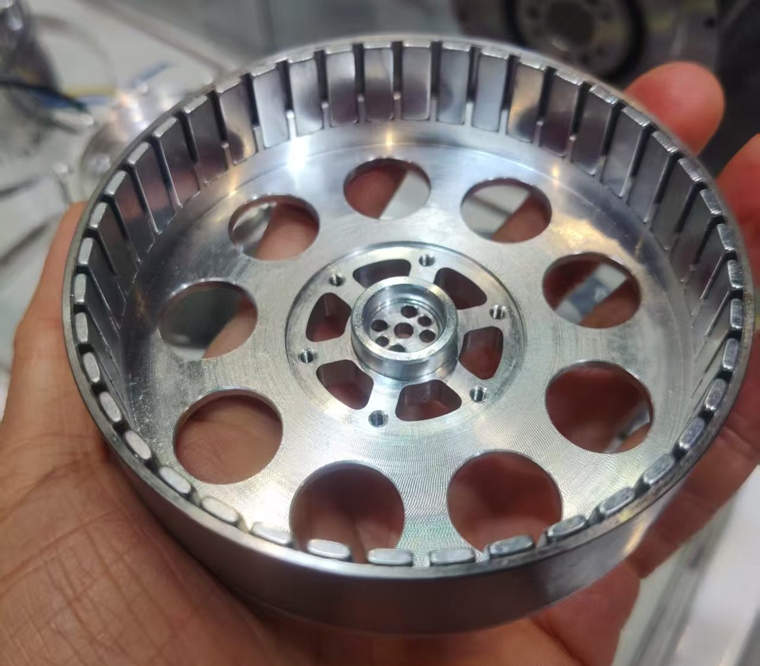
The number of magnetic poles also affects the motor’s dimensions and manufacturing costs. High-speed, low-pole motors, which derive their power from high rotational speeds, can generally be designed to be more compact; whereas multi-pole motors, in order to achieve greater torque, typically require more permanent magnets, a larger rotor diameter and a more complex magnetic circuit design, and are therefore often larger in overall size. Furthermore, motors with multiple poles—whether using individual magnets or magnetic rings—place higher demands on magnetisation equipment, assembly precision and dynamic balancing. The increased number of magnets also raises material and production costs; consequently, manufacturing costs are generally higher than for motors with fewer poles.
Furthermore, the greater the number of magnetic poles, the more demanding the requirements on the motor control system become. As the rate of change in the electrical angle is faster, the controller requires greater processing power, and Hall sensors, magnetic encoders and FOC control algorithms must all offer higher precision and response speeds; otherwise, operational stability and control performance are likely to be compromised.
The above outlines the impact of the number of magnetic poles on a motor’s speed, torque, dimensions and cost. For high-speed, compact products, designs with fewer poles are generally preferred, whilst equipment requiring low speed, high torque, direct drive or high positioning accuracy is better suited to designs with more poles.
Introduction to motor magnets;
Effects of Missing Installed Backwards or Weak Magnetism in Motor Magnets