 China Neodymium And Ferrite Magnets Manufacturer & Supplier



The main shapes of magnets used in motor rotor magnets include arc, rectangular, fan-shaped, and hollow cylindrical. They are primarily distributed through surface-mounting and embedded methods. So, what impact do these two different distributions of magnets have on the rotor performance?
First, let's talk about the surface-mounted structure, where the magnetic steel is directly bonded or fixed to the outer surface of the rotor core (either the outer circumference of the inner rotor or the inner wall of the outer rotor). This structure allows the magnetic energy of the magnet to be directly applied to the air gap, thus achieving near-ideal magnetic field utilization. This characteristic makes it particularly suitable for motors with high power density requirements, such as model airplane motors, servo motors, and some high-speed brushless motors.
In terms of thermal management, the surface-mounted structure also has certain advantages. The magnetic steel is directly exposed to air flow, which helps dissipate heat and reduce temperature rise.
However, its disadvantages are also quite obvious. The magnetic steel relies on adhesive fixation, which is prone to be affected by strong centrifugal force during high-speed rotation.
Sintered neodymium arc-shaped magnets for motor rotors
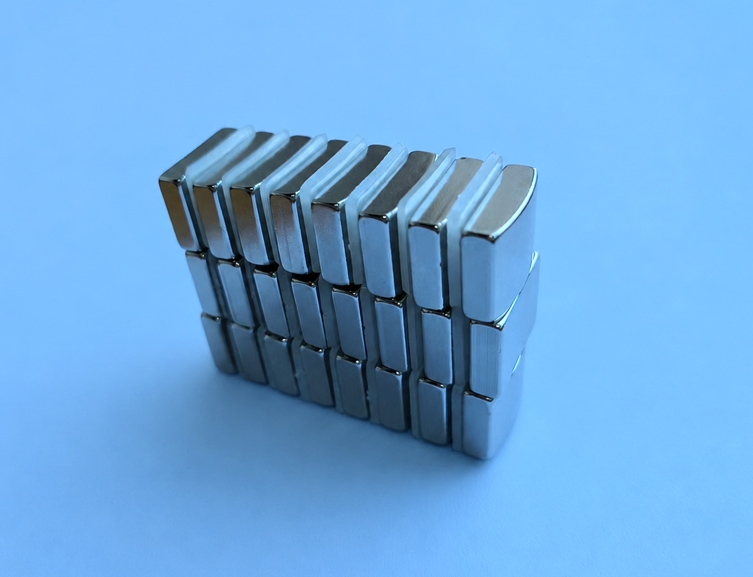
The embedded structure involves embedding the magnetic steel into the rotor core, forming a magnetic shielding and supporting structure through the core. This design places greater emphasis on mechanical stability and high-speed performance.
In terms of mechanical strength, the magnetic steel is firmly wrapped by the iron core, effectively resisting the huge centrifugal force generated by high-speed rotation, making it highly suitable for high-speed motors.
In terms of magnetic circuit design, embedded magnets can adopt tangential, radial, or composite arrangements. By optimizing the magnetic circuit structure, torque output and inductance characteristics can be improved, and in some designs, power density can be increased by approximately 20% to 30%.
Since the magnetic steel is enclosed within the iron core, the magnetic field is more constrained, resulting in less magnetic flux leakage and more efficient utilization of magnetic energy, which helps to improve the overall efficiency and stability of the machine. However, this structure also comes with a certain cost, as the heat dissipation path is restricted.
From the perspective of engineering applications, there is no absolute superiority or inferiority between surface-mount and embedded types; rather, they differ in their performance orientations.
Guess you are interested in;
What performance of motor can be improved with good segmented magnet