 China Neodymium And Ferrite Magnets Manufacturer & Supplier



In magnetic encoders, customers commonly use dual-track (channel) magnetic rings. Where there are dual-track versions, there must also be single-track ones—so what are the differences between them and single-track magnetic rings?
Single-track magnetic ring has only one magnetised track and works in conjunction with a single sensor; it can provide speed feedback and rotation detection, but without additional logic or further sensors, it cannot directly determine the direction of rotation on its own. In contrast, dual-track magnetic rings utilise the phase difference between two signal channels to provide directional information.
In terms of resolution, dual-track magnetic rings employ quadrature decoding, which can quadruple the effective resolution. For example, a 50-pole-pair magnetic ring can achieve 200 counts per revolution with quadrature decoding, whereas a single-track system achieves only 50 counts.
In terms of immunity to interference, as the dual-channel signals can cross-check each other, it is easier to filter out erroneous pulses caused by vibration or electromagnetic interference during the signal processing stage, thereby enhancing system stability.
Dual-track magnetic rings with 32 pole pairs on the outer ring and 31 pole pairs on the inner ring, available in a variety of materials
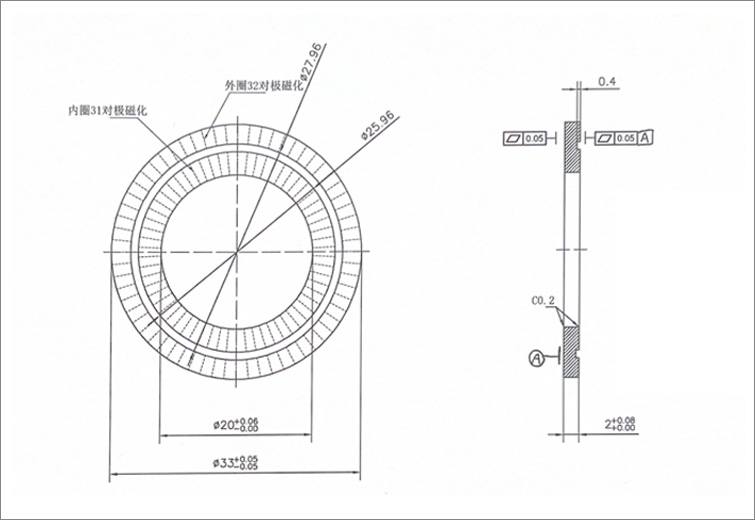
In terms of structural integration, compared to using two single-track magnetic rings side by side, dual-track magnetic rings integrate both tracks into a single magnetic structure, reducing the axial space required and shortening the overall structural length by up to approximately 30%–40%.
As for the price—a point of interest to many—dual-track magnetic rings require two sensors and more complex electronic processing circuits, resulting in a slightly higher cost. However, in applications with high performance requirements, this performance enhancement is generally worthwhile.
Finally, regarding their applications: single-track magnetic rings are commonly used for simple speed measurement, such as fan speed detection, cost-sensitive motors and unidirectional motion systems. Dual-track magnetic rings, on the other hand, are predominantly used for precision control of brushless motors, servo systems, closed-loop control with encoder feedback, and robotic joints.
The above outlines the differences and comparisons between dual-track and single-track magnetic rings. Should you require samples or pricing information, please provide relevant details such as dimensions and number of poles.
Double-ring magnetised encoder ring magnet;
Robot Encoder Dual-Channel Magnetic Ring 56x38x1.1mm
2 Track multipole 62 64 poles axial encoder disk 29x15x1.1mm
Encoder single-sided multipole ferrite ring magnet 34mm x 2.5mm