 China Neodymium And Ferrite Magnets Manufacturer & Supplier



Plastic-bonded ferrites (injection-moulded ferrites) are characterised by their light weight, high dimensional accuracy and ease of machining into complex shapes, and are widely used in products such as motors, sensors and magnetic encoders. However, as plastic-bonded ferrites are composed of a composite of ferrite magnetic powder and a plastic binder, there are certain details that require particular attention during use; failure to observe these may affect product performance and service life.
Avoid use in high-temperature and high-humidity environments wherever possible
The binder in plastic-bonded ferrites is susceptible to temperature and humidity, so prolonged operation in high-temperature or high-humidity environments is not recommended. Generally, the maximum operating temperature should be kept within 100–120 °C, whilst the minimum should be above –35 °C. If temperatures fall too low, exceeding the tolerance range of the nylon (PA) binder, the material may become brittle, leading to issues such as cracking or fracture.
When using in high-humidity or aquatic environments, care must be taken in selecting the binder
If plastic-coated ferrites are to be used for extended periods in high-humidity environments or in water, it is essential to consult the manufacturer to confirm the material formulation. Standard nylon-based binders may be prone to water absorption, which can lead to dimensional changes and a reduction in mechanical strength, thereby affecting product stability. For such applications, it is recommended to select a PA12 binder that is resistant to water absorption to enhance the product’s moisture resistance.
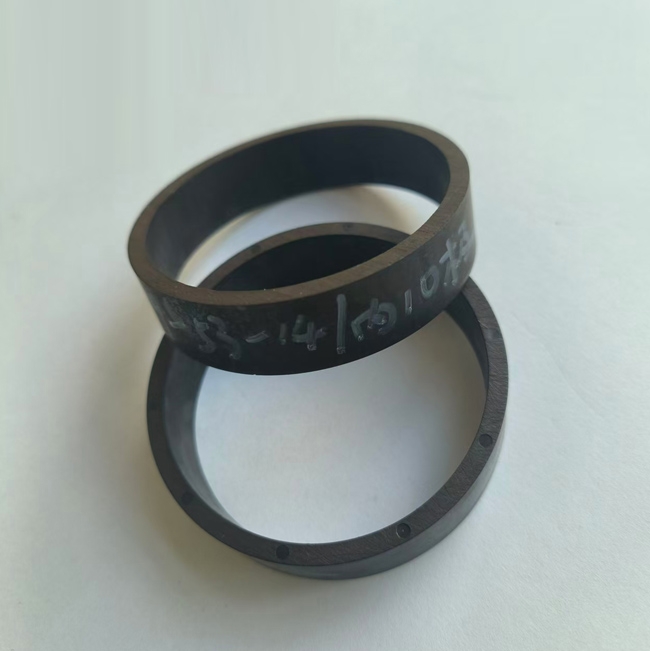
10-pole plastic ferrite magnetic ring
Avoid contact with corrosive substances such as strong acids and strong alkalis
Although plastic-coated ferrite is more corrosion-resistant than ordinary metallic materials, prolonged contact with chemicals such as strong acids and strong alkalis may still affect the adhesive and magnetic properties.
Avoid prolonged storage alongside powerful neodymium magnets
Once plastic ferrite has undergone specific magnetisation, its magnetic pole distribution is fixed. Prolonged proximity to strong magnetic fields, particularly those from powerful neodymium-iron-boron magnets, may affect the magnetic field distribution of the plastic ferrite, leading to magnetic pole misalignment or changes in magnetic properties.
Confirm the magnetisation direction and magnetic performance requirements before use
Before installation and use, it is necessary to confirm that the polarity is correct to avoid issues such as abnormal motor operation or inaccurate sensor readings caused by incorrect assembly.
The above outlines the precautions for using plastic ferrite magnets. Should your company wish to purchase these or seek samples of injection-moulded magnets, please feel free to contact us via WeChat or submit an online enquiry.
Highly related articles;
Learn About Plastic Bonded Ferrite Magnets
Sintered Ferrite Magnets VS Injection Molded Ferrite Magnets