 China Neodymium And Ferrite Magnets Manufacturer & Supplier



The AS5045 is a 12-bit magnetic rotary encoder launched by ams, offering a resolution of up to 4096 positions per revolution. This chip requires only a two-pole magnet mounted at its centre to achieve a full 360° range. Today, we will discuss the magnets used in the AS5045.
Firstly, regarding the material of the magnet, the manufacturer recommends rare-earth neodymium-iron-boron, samarium-cobalt or aluminium-nickel-cobalt. Most customers opt for neodymium-iron-boron magnets, with grades N35–N42 sufficient to meet application requirements.
As for magnet dimensions, the data sheet recommends a circular magnet with a diameter of 6 mm and a thickness of 2.5–3 mm,Radial magnetisation (Very important).
Regarding magnet mounting, the magnet can be positioned either above or below the chip. The official recommended mounting distance is 0.5–1.5 mm, with an optimal range of 0.8–1.2 mm. The required magnetic field strength is 45 mT to 75 mT, equivalent to approximately 450 to 750 gauss (at the chip’s detection point). An excessively strong magnetic field may cause the internal preamplifier to saturate, resulting in measurement errors. Conversely, if the magnetic field is too weak, noise will become a more significant factor, also leading to errors.
Magnet mounting distance for the AS5045 12-bit programmable magnetic rotary encoder
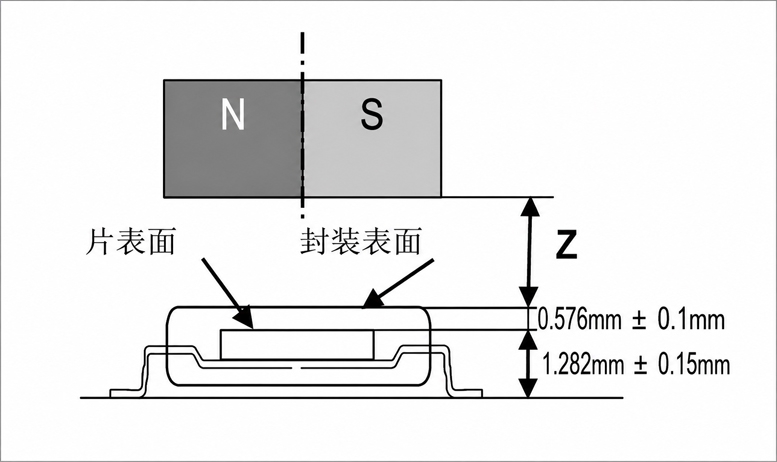
AS5045 specifies that the offset between the centre of the magnet and the centre of the chip must be ≤0.25 mm; the closer to the centre, the better, and it is recommended to keep this within ±0.1 mm.
In practical applications, the use of a Φ6 × 3mm radially sintered neodymium-iron-boron disc magnet with a 1 mm mounting clearance typically yields the best encoding accuracy and stability.
Related products;