 China Neodymium And Ferrite Magnets Manufacturer & Supplier



The measurement accuracy of a magnetic encoder depends not only on the chip itself, but also on the material, dimensions, magnetisation method and mounting distance of the accompanying magnet. Magnetic encoder chips based on different principles have significantly different requirements in terms of magnetic fields; therefore, one cannot simply apply the same magnet solution across the board when selecting a model.
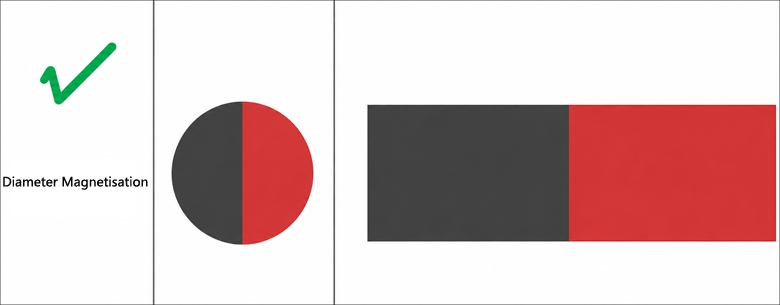
Hall-effect magnetic encoders, such as the AS5600, AS5045 and AS5048, require a high degree of magnetic field uniformity. As these chips calculate angle by detecting changes in the magnetic field, it is generally recommended to use radially magnetised circular magnets; a common configuration is an N35-grade neodymium-iron-boron magnet with a diameter of 6 mm and a thickness of 2.5 mm, mounted at a distance of approximately 1 mm.
AMR magnetic encoders, such as the MT6816, MT6835 and MT6835, operate on the principle of the magnetoresistance effect. They are relatively sensitive to changes in the direction of the magnetic field, but have relatively low requirements regarding the uniformity of the magnetic field. As they are capable of stable operation with a large air gap, radial-magnetised neodymium-iron-boron magnets with a diameter of 8 mm or 10 mm may be selected, such as 10 x 2.5 mm. In standard environments, N35 grade is suitable; in high-temperature environments, a higher temperature-resistance grade is required. The distance between the chip surface and the magnet should be maintained at approximately 3 mm.
Radially magnetised circular magnets
GMR magnetic encoders (such as the TLE5012B, HGPRDT007A and AD004-00E) offer higher magnetic field sensitivity and are capable of detecting both parallel and perpendicular magnetic fields, making them particularly suitable for off-axis detection and applications involving magnetic ring structures. In practical design, larger radial or axial magnetised ring-shaped, circular or block magnets may be used; for example, the HGPRDT007A datasheet recommends a 4-pole ring magnet with an outer diameter of 30 mm, an inner bore of 12 mm and a thickness of 5 mm.
Regardless of the principle on which a magnetic encoder is based, it is important to note that the relationship between magnetic field strength and mounting distance is not linear. Once the distance from the magnet exceeds a certain critical value, the magnetic field strength decays rapidly.
Generally speaking, radially magnetised magnets are the most common solution in magnetic encoder applications, whilst the proper control of the air gap and the maintenance of magnetic field stability are key to achieving high-precision measurement results.
That concludes this article. Should you require magnets compatible with sensors or encoders, please do not hesitate to contact us for assistance.
Recommended magnets;
Diametrically magnetized disc magnets 6x2.5mm nickel
Hall component radial small neodymium disc magnet 8mm x 2.5mm
2 Track multipole 62 64 poles axial encoder disk 29x15x1.1mm