 China Neodymium And Ferrite Magnets Manufacturer & Supplier



Many people choose magnets based solely on size and magnetic strength, unaware that every detail—from dimensions and shape to plating processes, grade specifications, and operating environments—directly determines whether a magnet is suitable for the job, how long it will last, and whether the cost is reasonable. Rather than delving into microscopic principles or everyday applications, this article focuses on practical aspects such as industry-specific selection criteria, shape and application, differences in coatings, the meaning of grades, and suitability for operating conditions. It provides an in-depth breakdown of specialized magnet knowledge that is often unknown to the general public.
1. Different Shapes of Magnets Serve Different Uses
Although they are all neodymium magnets, round, square, ring, bar, and custom-shaped varieties may appear to differ only in their external form, but their intended applications are entirely different, and they cannot be interchanged arbitrarily.
For example, square block magnets distribute force evenly, are easy to install, and offer the greatest versatility. They are commonly used in electronic components, magnetic fastening, magnetic separation equipment, and tooling fixtures. As the most widely used standard type in industry, they are ideal for flat surface mounting. Cylindrical magnets concentrate force and provide precise positioning, making them suitable for hole-mounted applications and sensor detection. Their compact size saves space, making them ideal for small, precision components. Ring magnets feature a central hole for shaft insertion or screw fastening. They are specifically designed for motor rotors, loudspeakers, and magnetic couplers, utilizing the ring-shaped magnetic field to form a closed loop, resulting in minimal magnetic loss. W-shaped and curved magnets are common shapes for motors. Their curvature conforms to the circumference of the stator and rotor, making them a specialized structure for new energy motors and fan motors. Standard square magnets cannot fully replace them; even slight deviations in curvature can affect operational efficiency and noise levels. Specially shaped magnets, such as trapezoidal, stepped, and slotted magnets, are all custom-made according to equipment structures to fit specific installation spaces, reduce assembly errors, and enhance the overall stability of the equipment.
2. The magnet's coating determines its service life and corrosion resistance
Magnets, especially neodymium-iron-boron magnets, are prone to oxidation and rust due to their material composition. The plating acts as a protective coating, and since different plating options vary significantly, selecting the right one is crucial. Zinc plating offers the best value for money; it has a blue-white surface and provides moderate corrosion resistance. It is suitable for dry indoor environments, general electronic components, and temporary fixtures. It is low-cost but has a plain appearance. Nickel plating is now primarily a three-layer process (nickel-copper-nickel). It features a bright, wear-resistant surface and offers far superior rust, corrosion, and impact resistance compared to zinc plating. It is suitable for outdoor equipment, humid environments, and precision instruments, making it a high-end option commonly used in industry. Epoxy resin coatings feature a black resin surface and offer the highest level of corrosion resistance. They are resistant to acids, alkalis, moisture, and salt spray, making them suitable for outdoor open-air applications, wastewater treatment, and high-salinity coastal environments. They are unlikely to rust or peel even with long-term use. Uncoated products, however, are only suitable for temporary use in dry indoor environments. They must not come into contact with water or moisture, as they will quickly oxidize and chalk. They are generally not recommended for routine use.
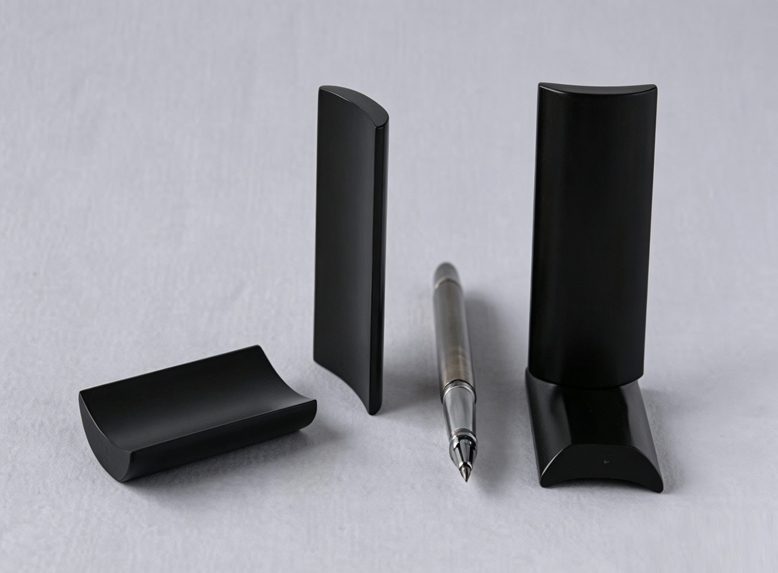
Epoxy-coated neodymium arc magnets
3. The Technical Meaning Behind Magnet Grade Numbers
We often see designations such as N35, N38, N52, SH, and UH. These are not arbitrary codes; each designation represents the strength of the magnetic field and the temperature resistance rating.
The higher the first number, the stronger the magnetic force: N35 < N38 < N42 < N52. For the same volume, N52 has far greater magnetic pull than N35, and high-end equipment typically uses higher-grade magnets. The suffix letters indicate temperature resistance: Standard N: up to 80°C at room temperature; M-grade: 100°C; H-grade: 120°C; SH-grade: 150°C; UH-grade: 180°C.
Many cases of demagnetization in equipment occur when magnets designed for room temperature are used in high-temperature environments.
4. Hidden but Strict Requirements for Magnets in the Work Environment
When selecting magnets, one must not focus solely on magnetic pull; they must be matched to actual operating conditions. These three details are most easily overlooked. Temperature Environment: For high-temperature equipment, high-temperature-resistant grades must be selected; for low-temperature environments, standard grades may be used. Humidity and Acids/Alkalis: In workshops with high humidity, water, or acid/alkali mists, epoxy resin or nickel-plated magnets must be used; standard galvanized magnets are not suitable, as they will rust and flake off quickly. Vibration and Impact Environments: Neodymium magnets are brittle and fragile. For equipment subject to prolonged vibration or frequent impacts, they must be secured with adhesive and fitted with protective casings to prevent cracking or chipping. Installation Distance and Magnetic Permeability: Thin plastic or cardboard has virtually no effect on magnetic force, but iron or steel plates significantly weaken the holding power. Magnetic field strength decreases rapidly with distance; therefore, a reasonable holding distance must be accounted for during selection.
Many people consistently make these common mistakes when selecting magnets
Focusing only on size, not grade: Magnets of the same size have significantly different holding forces—N35 and N52, for example;
Using standard galvanized magnets for outdoor applications: They rust quickly and eventually flake off, affecting equipment performance;
Using standard N-grade magnets in high-temperature equipment: They gradually demagnetize over time, leading to a loss of magnetic strength;
Mixing different materials: Ferrite and neodymium magnets have vastly different magnetic field strengths and cannot be interchanged arbitrarily during assembly.
Selecting a permanent magnet essentially involves finding the optimal balance between performance, temperature, lifespan, size, and cost. When making a selection, one should first identify the specific application scenario and then conduct a comprehensive evaluation that takes into account magnetic performance requirements, operating temperature, magnetization methods, and industry-specific characteristics.