 China Neodymium And Ferrite Magnets Manufacturer & Supplier



Against the backdrop of electronic devices continuously evolving toward greater thinness, lightness, and high reliability, magnetic connectors are gradually transitioning from niche applications to mainstream use. Whether in smartphones, tablets, wearable devices, or various industrial and medical equipment, magnets are playing an increasingly vital role within connector systems. Below are some applications and considerations regarding magnets in connectors.
The primary functions of magnets in connectors include rapid magnetic attachment and positioning to enable blind-mate functionality. They reduce insertion and extraction force while extending service life. Additionally, they facilitate weight reduction and structural simplification.
The core advantage of magnetic connectors lies in their “auto-alignment” feature. Magnets embedded within the connector automatically snap together when the user approaches the interface, ensuring precise terminal alignment. This significantly reduces misalignment during insertion and removal, minimizing mechanical wear. This capability is particularly crucial for wearable devices, children's products, and scenarios requiring one-handed operation.
Illustration shows the magnet structure of a magnetic connector.
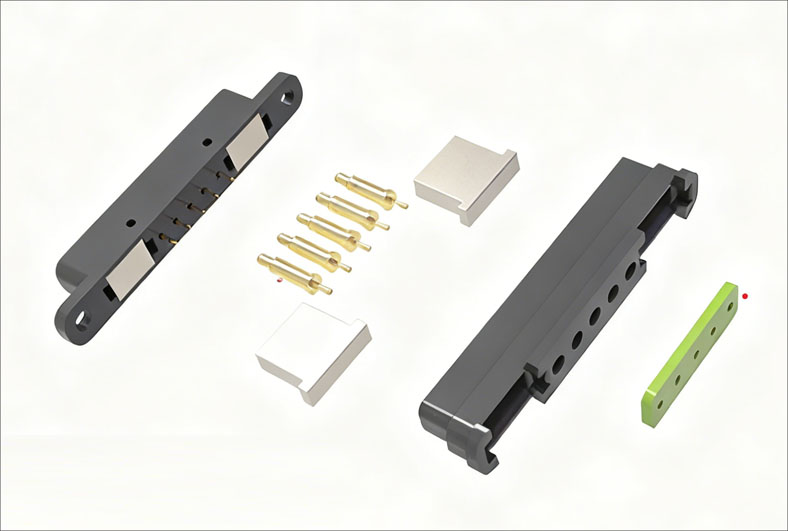
Traditional mechanical connectors rely on friction from metal springs for retention, whereas magnetic connectors maintain connection through magnetic force, eliminating the need for excessive insertion or removal force. Consequently, terminals experience less wear and tear, typically extending their lifespan by 2 to 5 times, making them highly suitable for devices requiring frequent plugging and unplugging.
Replacing mechanical latches with magnets reduces the number of structural components in connectors, enabling thinner, lighter, and more flexible interfaces. This is especially valuable in products with millimeter-level space constraints, such as smartphones and TWS earbuds.
Typical Applications:
Apple Watch, Huawei smartbands/smartwatches, Mi Electric Toothbrush magnetic charging dock, AirPods, Huawei FreeBuds, magnetic protective cases, etc.
Currently, rare-earth neodymium-iron-boron magnets are predominantly used in magnetic connectors. They often require paired magnetization, with shapes varying by product—ranging from standard forms to specialized custom designs.
Key considerations include preventing reversed polarity installation. Incorrectly oriented magnets will prevent proper connection and misalign terminals. Therefore, magnet suppliers must provide NS polarity markings, and production must incorporate polarity detection fixtures.
Additionally, careful consideration must be given to size and strength selection. Neodymium magnets possess exceptionally strong magnetic properties. Oversized magnets may hinder smooth insertion/removal, while undersized ones risk disengagement.
The integration of magnets into connectors represents a significant trend in modern electronic structural design. This approach enables lighter, more durable, and safer connections. Should your company require magnetic solutions, please contact us for quotations and sample production.
Selection of connector magnets;
Custom shape convex disc magnets for connectors 14mm x 9mm
N52 Rod shaped stepped strong magnet for magnetic connection