 China Neodymium And Ferrite Magnets Manufacturer & Supplier



When it comes to multipole magnets, the two most commonly used types on the market today are multipole ferrite magnets and multipole neodymium-iron-boron magnets. Today, we will focus on multipole neodymium magnets, covering their definition, typical applications, types, and how to select them.
As for its meaning, it is quite straightforward: it refers to neodymium-iron-boron magnets with multiple north-south poles on their axial or lateral surfaces—such as 4-pole, 6-pole, 8-pole, 24-pole, or even more—which can generate a more uniform and precise magnetic field.
With the development of brushless motors, Hall sensors, encoders, and new energy vehicles, multipole neodymium-iron-boron magnets are being used more and more widely. Currently, the most common types of multipole neodymium-iron-boron magnets include sintered, injection-molded, and bonded varieties.
Multi-pole sintered neodymium magnets are manufactured using a powder metallurgy sintering process. They possess the strongest magnetic properties among these types and are typically available in flat ring or hollow cylindrical shapes. They can be magnetized axially or radially, with the number of poles generally limited to 2, 4, 6, or 8; producing magnets with a higher number of poles becomes relatively more difficult. This material is primarily used in brushless motor rotors, servo motors, drive motors for new energy vehicles, and high-power drone motors.
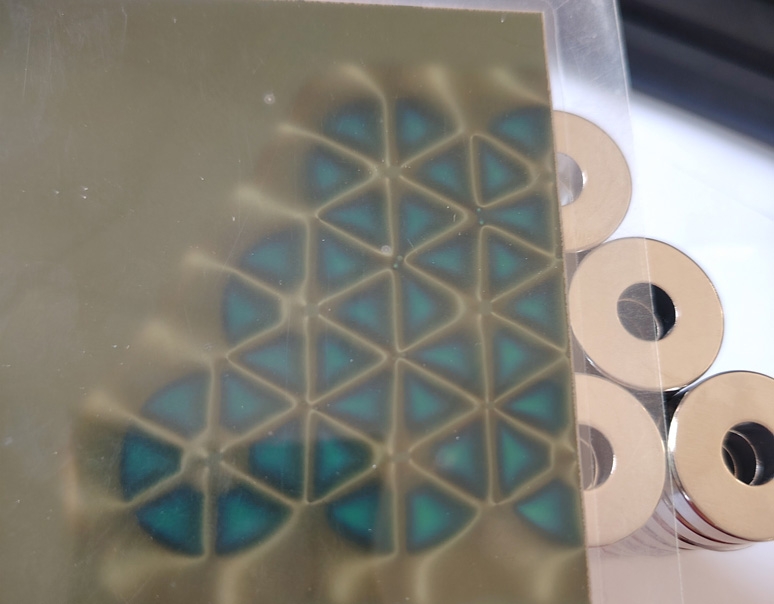
The image below shows an axial 6-pole sintered neodymium ring magnet.
Another type is the multi-pole bonded neodymium magnet, which is formed by compressing a mixture of neodymium-iron-boron magnetic powder and a resin binder. Its magnetic properties are stronger than those of injection-molded neodymium-iron-boron magnets but weaker than those of sintered neodymium-iron-boron magnets. Because the magnetic strength is not too high, multi-pole magnetization is easier to control than with sintered neodymium-iron-boron magnets. These products are commonly used in power tools, hair dryers, fan motors, massage guns, water pumps, and Hall effect sensors.
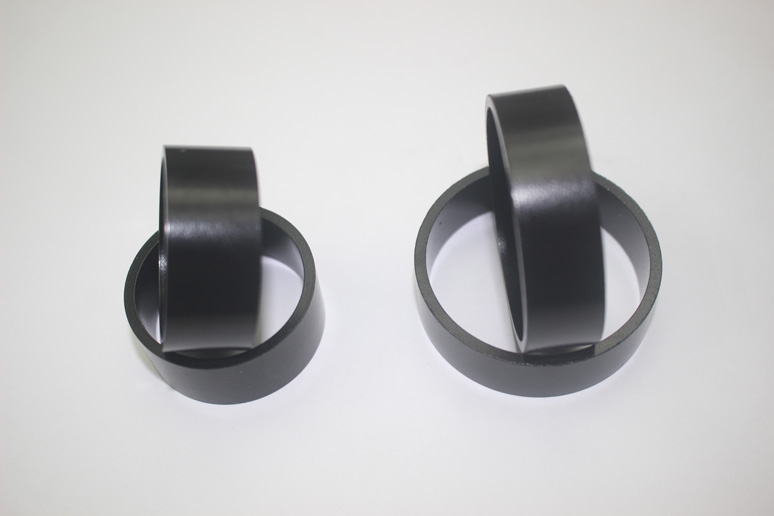
Multi-pole bonded neodymium ring magnet
The final type of multi-pole injection-molded neodymium magnet is manufactured in a single step via injection molding after mixing neodymium-iron-boron magnetic powder with engineering plastics. Its most notable feature is the ability to produce complex structures, such as those with gears, latches, and positioning holes; it can also be injection-molded as a single unit with a metal shaft. Additionally, it is not easily breakable. While it has the lowest magnetic performance among these three types, it is commonly used in automotive ABS wheel speed sensors, encoders, and smart home appliances.
How should I choose?
If maximum magnetic strength is the priority, multi-pole sintered ndfeb magnets are typically the best choice. If complex structures and high dimensional accuracy are required, multi-pole injection-molded neodymium-iron-boron magnets are recommended. If you need higher magnetic strength than injection-molded neodymium-iron-boron magnets but don’t require the strength of sintered magnets, choose multi-pole bonded neodymium magnets.
Editor's Picks;