 China Neodymium And Ferrite Magnets Manufacturer & Supplier



When disassembling radios, antenna equipment, or RF coils, many people discover a seemingly unremarkable gray-black ferrite magnetic rod that surprisingly lacks magnetic properties. What could be the issue here?
In fact, the commonly used ferrite magnetic rods in antennas belong to soft ferrite, such as MnZn and NiZn series. The characteristic of this type of material is not to provide suction, but to change the magnetic circuit, permeability, and improve antenna efficiency. A core feature of soft magnetic materials is the absence of remanence (almost no magnetic field is maintained), which rapidly demagnetizes even after being subjected to an external magnetic field. Therefore, using a magnet to attract it or using it to attract iron will not have any reaction, it looks like it has no magnetism.
The key to determining whether a material can absorb iron is its coercivity Hc. The coercivity of hard magnetic materials such as permanent ferrite and neodymium iron boron is very high, which can maintain a strong magnetic field for a long time and thus have attractive force; The soft magnetic ferrite used in the antenna has extremely low coercivity (usually 0.5-3 Oe), and will immediately demagnetize after magnetization, so it will not produce permanent attraction. This is intentionally designed to allow the material to respond quickly to signal changes without affecting high-frequency performance.
Ferrite rods for antennas come in both round and flat shapes.
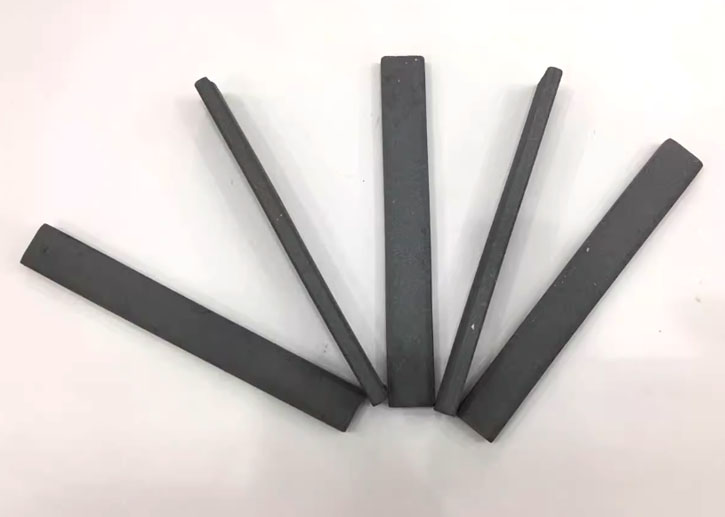
The true function of ferrite in antennas is to facilitate the passage of magnetic fields, improve the inductance and signal reception performance of antenna coils. It is like a 'highway of magnetic flux', helping to enhance magnetic field strength and stability, making antenna tuning more precise. If the ferrite itself is magnetic, it will damage the working point of the antenna coil, causing frequency drift and sensitivity decrease. Therefore, the antenna must use soft magnetic materials that do not absorb iron.
So the ferrite used in the antenna looks' non-magnetic ', it's not a quality issue, it's only responsible for magnetic conductivity, not for iron absorption. It does not carry suction or maintain a magnetic field, in order to make the antenna work more stable and sensitive, which is why it is widely used in high-frequency antennas, inductors, and EMI suppression.
Related Products;
1 inch height ferrite core rod for antennas 2.9x25.4mm
Radio medium wave antenna MnZn ferrite magnetic rod core 8x100mm