 China Neodymium And Ferrite Magnets Manufacturer & Supplier



Among numerous magnetic materials, ferrites are widely employed due to their low cost, excellent temperature resistance, strong corrosion resistance, and high resistivity. Based on manufacturing processes, ferrites are primarily categorised into bonded ferrites and sintered ferrites. Although both consist of ferrite magnetic powder, their distinct production routes result in significant differences in magnetic properties, temperature tolerance, and machinability. The following outlines some comparative distinctions.
Firstly, in terms of manufacturing process, bonded ferrite involves mixing ferrite magnetic powder with a plastic binder, followed by compression moulding or injection moulding. This results in a material containing a certain proportion of resin components, leading to a lower density. Sintered ferrite, however, employs a high-temperature sintering process that causes the magnetic particles to bond tightly into a dense structure, with virtually no resin or adhesive components present internally.
In terms of magnetic property differences, the remanence Br, coercivity Hc, and magnetic energy product BHmax of bonded ferrites are all significantly lower than those of sintered ferrites, typically exhibiting only 30–50% of the magnetic properties of sintered materials.
Product are ferrite ring with an outer diameter of 20mm.
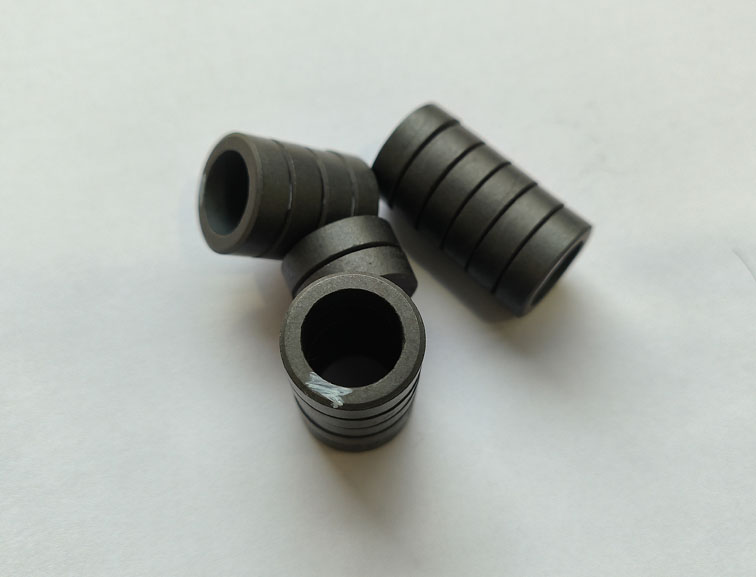
In terms of machining and cost, bonded ferrites, containing resin, can be injection moulded, making them suitable for complex structures such as those with columns or grooves. They offer high dimensional accuracy and low batch production costs. Sintered ferrites, being ceramic magnets, are highly brittle and difficult to machine. They are typically produced in traditional shapes such as rings, cylinders, or cubes, with machining often involving grinding wheels. Complex structures incur higher costs.
In practical applications, bonded ferrites are predominantly employed in precision, low-load, compact devices such as sensors, micro-motors, and encoders. Sintered ferrites, however, exhibit superior magnetic properties and are suited for applications requiring high magnetic flux, high-temperature resistance, and exceptional reliability, including motor rotors and loudspeakers.
The above outlines the principal distinctions between these two types. Should you require magnet quotations or sample provision, please do not hesitate to contact us via the contact details provided on our website.
Highly relevant articles;