 China Neodymium And Ferrite Magnets Manufacturer & Supplier



In recent years, an increasing number of customers have adopted injection-molded ndfeb magnets, with many opting for PA12 injection-molded neodymium magnets. As some may be unfamiliar with this material, Xiaofu has compiled a summary of its fundamental characteristics—including the meaning of its name, magnetic properties, and applications—hoping it proves helpful.
PA12 injection molded ndfeb is a composite permanent magnet material primarily composed of neodymium iron boron magnetic powder (NdFeB), with nylon PA12 (polyamide 12) added as the binding matrix. It is formed through an injection molding process. Unlike sintered NdFeB magnets, these magnets are formed by uniformly mixing magnetic powder with plastic and molding them in a single step. This process endows them with dual characteristics: “magnetic material + engineering plastic.” They retain the magnetic properties of NdFeB powder while also possessing nylon's flexibility, impact resistance, and dimensional stability, enabling the fabrication of complex structures.
The material properties of nylon PA12 confer superior comprehensive performance to injection-molded neodymium magnets compared to common PA6. PA12 exhibits lower moisture absorption, maintaining dimensional stability even under prolonged exposure to humid and hot environments, with minimal expansion or deformation. Regarding magnetic properties, typical maximum energy product reaches 5–8.5 MGOe, surpassing rubber magnets and ferrite magnets. This makes it suitable for applications like Hall sensor magnetic rings requiring multipolar magnetization and encoder magnets. Additionally, injection molding provides high mechanical toughness, preventing brittle fracture unlike sintered neodymium magnets.
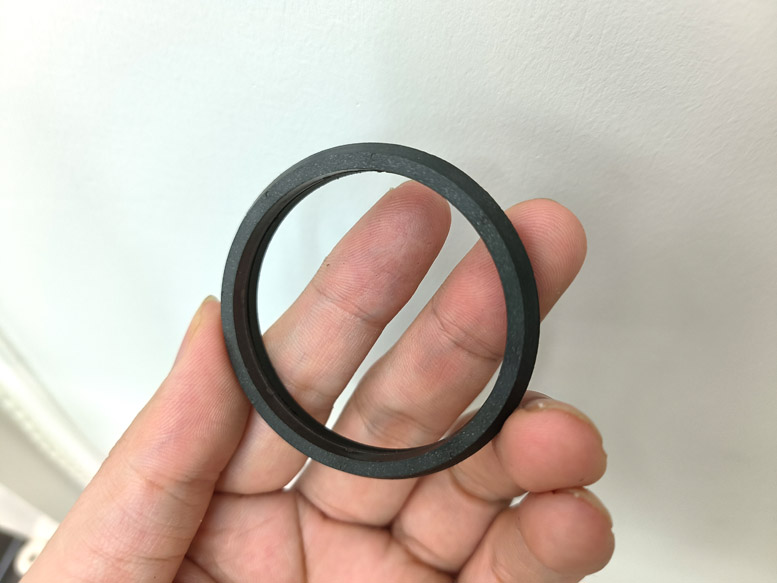
The image below shows a ring-shaped injection-molded neodymium magnetic ring.
Application Advantages and Typical Applications: PA12 injection-molded neodymium magnets easily achieve high-pole and multi-pole magnetization, supporting intricate geometries such as narrow slots, locating pins, and snap-fit structures. They can also be co-injected with inserts like metal shafts, copper sleeves, and plastic skeletons, enhancing product consistency and longevity. Widely used in automotive sensors (ABS, ESP, RPM sensors, electronic throttle pedals, seat angle sensors), brushless motor rotor magnets, rotary encoders and angle sensors, home appliances, and smart devices.
The above covers the introduction to the article title. If you require injection-molded neodymium iron boron samples or wish to inquire about pricing, please contact us. We support custom mold development.
Sample Case;