 China Neodymium And Ferrite Magnets Manufacturer & Supplier



Are the two poles of a magnet multipole magnetization? This is a common question among those who are new to magnetic materials. Below, we will try to explain it in simple and easy-to-understand language.
The most common magnets in our daily lives, such as decorative magnets attached to refrigerator doors, the magnetic needles in compasses, and the connectors of magnetic charging cables, are all typical two-pole magnets, also known as single-pole pair magnets. These magnets have only one N pole and one S pole, with magnetic field lines emanating from the N pole, passing through the external space around the magnet, and then entering from the S pole, forming a complete closed loop. This is the most fundamental and simplest magnetization method, and it is also the natural state exhibited by naturally occurring magnetite in nature.
Like bar magnets, disc magnets, or block magnets, any magnet with one N pole and one S pole at its ends is classified as a “two-pole magnet.”
Standard Thickness Magnetized Neodymium Square Magnets
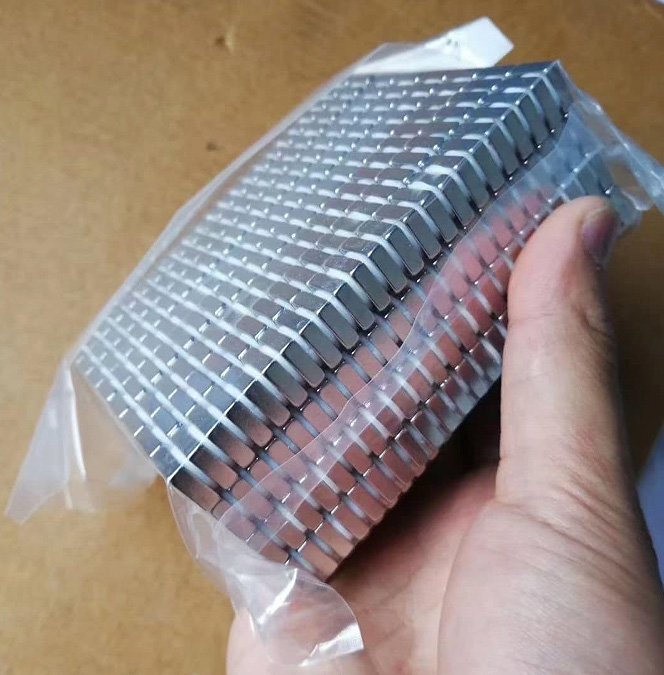
And how about multipole magnetization? It refers to the formation of multiple sets of N/S poles on a surface of the same magnet, such as 4 poles, 8 poles, 10 poles, 12 poles, 24 poles, etc. The magnetic field distribution of these magnets varies periodically and is commonly seen in magnetic rings, magnetic blocks/strips. Compared to ordinary magnets, multipole magnets have a more complex structure and require specialized magnetizing fixtures to achieve precise control of pole spacing and pole width.
The biggest difference between 2 pole magnets and multipole magnets lies in their applications and magnetic field distribution. The magnetic field of bipolar magnets is mainly concentrated on the upper and lower surfaces, suitable for traditional purposes such as adsorption, clamping, and positioning. The magnetic field of multipole magnets has a regular waveform, which is very suitable for Hall sensors to read angles, speeds, or positions. Therefore, they are commonly used in industries such as brushless motor rotors, rotary encoders, and fan speed measurement.
So a magnet with two poles is not considered multipole magnetization, it belongs to ordinary magnetization.
Articles with more views;