 China Neodymium And Ferrite Magnets Manufacturer & Supplier



A ring magnet refers to a circular magnet with a hole in the center. Simply put, the polarity of a ring magnet refers to the positions where the magnetic north pole (N) and magnetic south pole (S) are distributed on the ring magnet. Different magnetization methods cause the polarity to appear in different locations, resulting in completely different magnetic field distributions.
Common magnetization methods for ring magnets include axial magnetization (most common), also known as thickness magnetization, radial magnetization, multipole axial magnetization, multipole radial magnetization, skew angle magnetization (skew-pole magnetization), and radiation magnetization.
The following image shows the magnetic pole positions of various magnetization methods of ring magnet
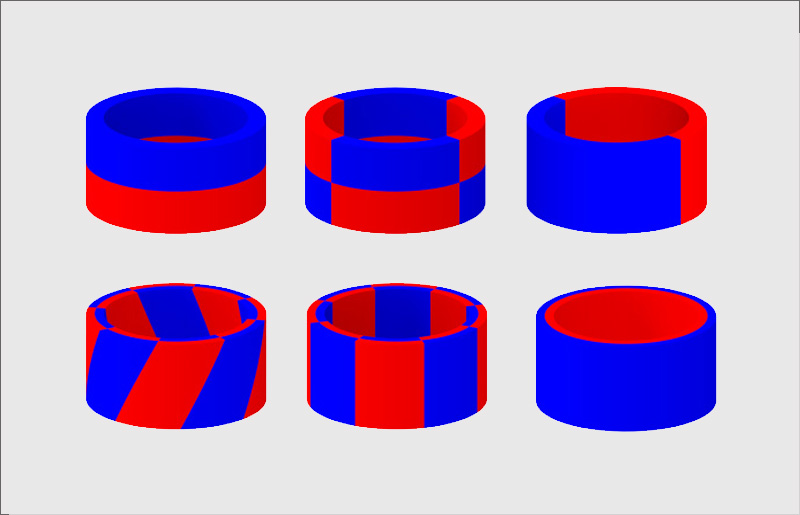
The magnetic poles of axial magnetization are distributed in two circular planes, one with the N pole and the other with the S pole. They are commonly used in speaker magnetic circuits and magnetic adsorption devices.
Radial magnetization poles are distributed on the side of the annular magnet, magnetized along the diameter direction, with a pair of N/S poles for the inner and outer diameters (such as N for the inner diameter and S for the outer diameter, or vice versa). Commonly used for motor rotors, sensors, and magnetic coupling.
Multipole axial or multipole radial magnetization refers to the alternating appearance of N and S poles in the axial or radial plane, such as 8 poles, 12 poles, 16 poles, 24 poles, etc. It is commonly used in angle sensors, magnetic encoders, speed measurement, and requires periodic magnetic fields.
If a ring magnet is magnetized with skewed poles (at an angle), its magnetic poles are not distributed with perfect radial symmetry. Instead, they are tilted at an angle along the circumference, such as 10°, 15°, or 20°. This configuration is commonly used in brushless DC (BLDC) motor rotors. Some high-resolution encoder magnetic rings are designed with a slight pole skew to improve signal smoothness.
Relevant oblique angle hollow cylindrical ring magnet samples; Right oblique orientation 8° magnetized hollow cylinder magnet 4 poles
As for radiation magnetization, after the ring magnet is made into radiation magnetization, the magnetic poles appear in the inner and outer rings, with the inner ring being the N pole and the outer ring being the S pole.
Radiation ring magnet sample: Radiation Sintered Ring Ferrite Magnet 25mm x 19.2 x 5 mm
The above is an introduction to the polarity of circular magnets. We can identify them through magnetic pole observation pieces, Gaussian meters, or magnets with known polarity. If you have any questions, please feel free to contact us.
You might be interested in: